
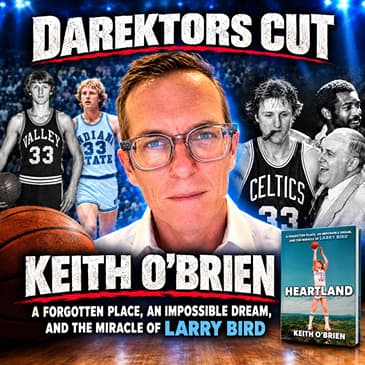
Episode 629
Heartland: "A Forgotten Place, an Impossible Dream, and the Miracle of Larry Bird"
Author: Keith O'Brien
Keith joins me to talk about his amazing book, all things Larry Bird from Indiana State to French Lick and everything in between.
Welcome, Keith O'Brien
#larrybird #larrybirdhighlights #boston #bostonceltics #nba #nbahighlights #bostoncelticsnews #indianastate #frenchlick #celticsnation #history #author #nbahistory #sportshistory #basketball #nba #basketballgame #basketballnews
Instagram: https://www.instagram.com/mondaymorningcritic/
Facebook: https://www.facebook.com/darektorscut
TikTok: https://www.tiktok.com/@mondaymorningcritic
darektorscut@gmail.com
darektorscut.com
[00:00:00] Larry Bird is no hick, believe me, but you could stick straw between his teeth and he could play the role and he could convince a lot of Mid-America that he was their boy. You have to kind of separate what he's saying sometimes because he can take people where he wants them, you know, he enjoys that. The media begs off with Larry because they're very afraid of him. They're afraid to somehow or another infuriate him. They're afraid to ask tough questions.
[00:00:24] He somehow or another has that way of intimidating the media as he intimidated players. We had a three-point contest at the All-Star break and Larry walks in and says, I hope all you guys in here are thinking about second place because I'm winning this. ... gonna drop one here quickly. Excuse me? And he started shooting and he just didn't miss. I remember going to Boston Garden for the first time. I couldn't wait to see it, walk on that floor.
[00:00:53] And I got there three, three and a half hours before game time. And the lights weren't even on on the court. But I heard a ball bouncing as I was walking through the corridor. And look who's here three and a half hours before the game begins. An hour before anyone else would even be in the building other than the popcorn vendor but Larry Bird. Larry Bird has always been afraid of failing. What did that make him do? It made him work harder than anybody else. You know, they talk about Larry Bird practicing in the rain.
[00:01:24] Larry Bird practicing out by himself all the time. Before games, after games. And I think that's the ethic that he brought from that small town environment. He knew the janitors and the equipment guys. And those were his guys more than the high roller luxury box guys. He doesn't like phonies. Stiffs them out right away. It's over and above the stomach and above the world.
[00:01:53] So I have to say, you know, for those listening, the book of the title is a pop heartland, a forgotten place and impossible dream in the miracle of Larry Bird. By the way, I love that title. Like it's as somebody who spent 53 years of his life, 53 years of his life in Massachusetts. I can really appreciate that. Thank you. The book, the book is about French flick in Indiana State and everything in between. It doesn't go so far as what some of the other books and documentaries have done.
[00:02:17] I might stretch it there with a few questions today, but the angle that you took was so unique and so original Keith. Did you feel like you hit on something? And I know Zach asked you a version of this question where he said, were you worried that you were going to get, you know, get a book deal? Whatever you wanted to say, what I just rambled on about. Well, I was confident in this story idea.
[00:02:41] Again, you know, for the last 50 years, we've been telling the Larry Bird story one way, always one way. We always weave together the stories of Larry Bird and Magic Johnson. And listen, I get it why we do that. You know, as a sports fan, I understand it. You know, they they, you know, of course, do play in that epic championship game in March, 1979, the last college basketball game. The two of them will ever play 50 million people watching most watched college basketball game of all time.
[00:03:08] Then they go on to spark a generational rivalry, save the NBA. So I get it. But in the 70s, they don't know each other. They've met one time. So it's a bit of a disingenuous narrative that we built and we built it because they play that one game in March, 1979. And the reality is in March, 1979, Larry Bird and the upstart shock the world, Indiana State
[00:03:37] Sycamores play a lot of future NBA stars. Mark Aguirre, Sidney Moncrief, et cetera. You know, Magic's just another one, really. And so what I wanted to do with this book was tilt the camera in a slightly different way, you know, zoom in from a different direction. And when you do that, what you end up getting is a completely different story and a completely different cast of characters, people we don't know.
[00:04:06] And these people were far more important to Larry Bird in the 1970s than Magic Johnson was. He was just a guy he played one time. So, you know, I felt confident that this was a story that has been had been sitting there just like a diamond sitting there on the surface of the soil for 50 years. And I fully believed it was the right approach to telling the Larry Bird story. Yeah. Yeah. Great answer.
[00:04:36] Let me ask you this. So how long did you spend in French Lick? Because as somebody who majored in history in college and uses it now, I can appreciate what you've done as far as a historian, as far as somebody who loves sports. It clearly seems like you poured your heart into this. So once you get to French Lick, how long are you there for? How long are you in Indiana? I guess because you weren't just in French Lick. You were in Terre Haute and some other places, I think. Just talk about that if you were my key. Multiple trips to Indiana. I mean, you can't. You can't.
[00:05:06] Two things. Every book I write, I give everything to because it's the only way to do it. You know, it has to consume you. It has to be the only thing you want to do with your time. It has to be that or it won't be good. It won't be as great as it can be. That's number one.
[00:05:27] Number two, you can't, you know, tell a story that is going to be really a portrait of a place and a time, not just a story of Larry Burr, but a portrait of a place and a time without investing significant amounts of time, you know, in visiting that place or those places. So it wasn't one or two trips to Indiana. It was multiple trips. I would, you know, go for the week.
[00:05:54] I would have a plan with how I was going to use my time. Again, you know, when you do a research trip like that, it's on my time. It's on my dollar. And so it's got I got to get the most out of it. And, you know, when I'm on the road for any story, whether it's for, you know, a magazine or for a book, the story is everything.
[00:06:21] And I will work long days in the service of that story. So whether that's in the library, you know, going through old news clips or other resources that exist in libraries or, you know, tracking down people and talking to them. You know, I spent a lot of time in Indiana doing that. And, you know, the libraries were just as crucial as at times as as the people.
[00:06:48] You know, we live in a world now where a lot of things are digitized. And that's amazing for historians and journalists like me. But there's a lot of stuff that isn't digitized. And, you know, in this case, you know, the Springs Valley Herald, the local paper in French Lick in the 60s and 70s, it's not digitized. It's only in the library in French Lick, Indiana. It's the only place you're going to find it in the whole wide world.
[00:07:17] The Terre Haute Star and the Terre Haute Tribune. Yes, Terre Haute, Indiana had two papers in the 1970s. What a gift to researchers. Had two papers there again, not digitized for the most part. They only exist in the Terre Haute library there in downtown Terre Haute, the Vigo County Public Library.
[00:07:43] So, so many days and nights spent in those libraries scrolling through microfilm or, you know, in the case of the Springs Valley Herald in French Lick, literally on my hands and knees with the hard bound, you know, paper version of the newspaper flipping page by page again in service of the story. Yeah, that's amazing. You know, you wrote an awesome book about Charlie Hustle.
[00:08:12] Probably a stretch of a question here. Are there any parallels between Larry and Pete? Oh, sure. Plenty. You know, obviously, Pete Rose and Larry Bird, very different humans. You know, Pete makes a great many mistakes in his life and lies about those mistakes, pays terrible prices for his choices.
[00:08:35] Bird, for the most part, you know, has lived a really clean life for a guy who's been in the spotlight for the last 50 years. You know, not perfect by any stretch, but not Pete Rose either. So they are different on their face, but they are, you know, sort of united by a few similarities. You know, they're both working class guys from gritty, tough, working class backgrounds.
[00:09:05] They both, and I believe this to be true, not because it's my opinion, but based on my reporting, both of them easily could have slipped away forever. There are, there is an alternative universe out there where Pete Rose never becomes famous, never becomes anybody. There is an alternative universe out there where Larry Bird never gets out of French Lick, never gets out of Southwestern Indiana. I totally believe that. So they come from nothing. They could have disappeared.
[00:09:35] Their fathers and both of their stories loom large for different reasons, but they do loom large in their life, you know, affecting their lives. And then, you know, lastly, you know, they worked for what they got. Yeah. You know, Pete Rose had talent and yeah, Larry Bird had talent. They worked for that talent.
[00:09:59] And they really did, you know, work on the craft of what they did. You know, yeah, Pete wanted, Pete Rose wanted to win baseball games and Larry Bird, of course, was a winner as well. Desperate to win. Desperate to win. But they both really lived in the service of their craft. You know, Pete Rose loved the batting cage.
[00:10:23] I would submit that Pete Rose loved the batting cage as much, if not more than he liked the games. He loved hitting for the sake of hitting. Larry Bird loved shooting for the sake of shooting, would live in the gym, would live at the at the outdoor basketball court in West Baden Springs, Indiana as a boy, would live in the Springs Valley gym and French Lick.
[00:10:51] And in one of the most haunting scenes in my book would live at the boys club in Terre Haute in the first year he spends at Indiana State. Remember, you know, Bird briefly had committed and enrolled at Indiana University to play for Bobby Knight and then leaves there after three weeks. It's in that, you know, next year where Bird really, truly does almost disappear forever.
[00:11:20] And then he comes back and goes to Indiana State. And remember, back in those days, a player, a young player who made a bad decision that he or she regretted had to pay a price for that poor decision, had to sit out the entire next year as a transfer. That was a really hard year for Larry Bird. He nearly quits basketball again. He nearly goes back to French Lick again.
[00:11:47] And it really is only the intervention of his coaches at Indiana State who get him a key to the boys club in Terre Haute, where he can now come and go as he pleases, shooting basketballs alone late at night, 12, 1 a.m. There's Bird in the boys club shooting and shooting. Mm-hmm. Great answer. Let me ask you this.
[00:12:15] In that time where Larry almost loses himself, that also includes his father's suicide, correct? Is that time frame correct? Yes. Yeah, yeah. And, you know, I have to tell you, I was dying to ask you this and other questions, but especially this. So, you know, there's a documentary. I have a clip I want to show you if there's time at the end for like a minute. But in that same ESPN 30 for 30. I don't think it's a 30. It came out in early 2000s. There's a Bobby Knights talking about Bird. And he said, I wasn't in tune to what he needed.
[00:12:43] But I always felt like Bobby was more flip about. I don't think he I almost think he was. He didn't realize what Larry was. I don't even think he was going to give Larry a chance. But in that same vein, is it fair to say Bird was bullied at Indiana for those three weeks? Is that too harsh of a word? You know, I don't know if bullied is the right word. I spoke with many people who were there in those three weeks, late August, early September 1974.
[00:13:13] Through my reporting, I pinpointed the exact day that Bird leaves Bloomington. It's Friday, September 13th, 1974. I spoke to his roommate. I spoke to his teammates. I spoke to staff and coaches. It's clear that, you know, Bird isn't considered, you know, a great asset to that team.
[00:13:40] But remember, that team in that locker room in Bloomington that summer, late summer, 74, is going to go 63-1 without Bird in the next two years. They're going to lose one game in two years, even after he leaves. They're incredibly good. They're an all-time team. If Bird stays, in my opinion, they might have won four in a row.
[00:14:07] I mean, Knight might have strung together even more than that. He might have strung together a John Wooden-esque dynasty, you know, spilling right out of the mid-'70s to the Larry Bird peak to Isaiah Thomas. I mean, it could have just rolled on, right? Yeah, yeah. So it's a really good team. And, yeah, they don't think that much of Bird.
[00:14:33] And, you know, I remember talking to Jim Wissman, you know, his roommate, another freshman. And, you know, Wissman said, you know, Bird was unhappy. Bird is grousing about lots of things, including how he's being treated or not treated on the basketball court. But Wissman told me that he and another freshman both sort of shrugged and were like, what's the big deal, Larry? What's the problem? Like, they didn't understand why he took it so personally.
[00:15:03] But I will agree with you about one thing you said. You know, Knight doesn't know what he has in Bird. He has no idea. Yeah, Bird had put up great numbers at Springs Valley High School in French Lick. But he had only done it for one season. Only his senior year. And he had only done it against other small rural schools.
[00:15:29] The moment Springs Valley High School plays a large school in the playoffs that spring, spring of 74, Bird gets shut down and Springs Valley loses. So Bird's not first team All-State 1974. I mean, I want people to think about this for a second. The great Larry Bird is not first team All-State 1974 in Indiana. He is not second team All-State 1974 in Indiana. He is honorable mention All-State.
[00:15:59] He makes the state All-Star team, which was a big deal. But he really only makes it because of politicking behind the scenes by a rural sports reporter down in southwest Indiana. Once he makes that team, he's not starting. At times, he's not playing much at all. So, yeah, Knight doesn't know what he has in Bird.
[00:16:24] And Knight was correct when he said he did not know what Bird needed because he didn't know him at all. You know, Knight suffered from a flaw that many great men suffer from, that Pete Rose suffered from. It's hubris. You know, Knight knows he's got a great team and he doesn't know this kid from French Lick. He doesn't know how good he is.
[00:16:49] And so, when Bird announces that he's leaving, Knight shrubs his shoulders and moves on. Yeah, yeah. Because I thought my interpretation, I could have been wrong, but like, you're right. It was a phenomenal team in Indiana. But I also felt like players just didn't respect him. And I thought if that was the case, if it did unfold to what I thought it did, that Larry would have fought back. Like, if that was the case, because Larry, which I learned about in your book, in the audio version, I was like, oh, my God.
[00:17:19] I never realized how much this guy. Well, I knew he fought because he fought in bars in Boston. He fought against the Lakers, Pistons. I can go on and on. Didn't realize New Mexico State, Cuba. Like, oh, goodness, Keith, this guy. I mean, where does he get this? So, I'll let you answer that. Then I have a follow-up. Where does he get the fight? No, the fight. No, the fight. Because I feel like, where does this come from? Like, he goes, he's this kid that's lost, obviously. We all would be. What happens to his dad?
[00:17:48] He's searching for himself. He clearly finds himself. Is the aggression coming from what he has experienced in his life? Does he become, does he come to a point where he's like, you know, listen, you know, where does it click for him? Where does it, where does he, where's this, where's this guy come, this version of Larry? Where does that come into play? Well, you're sort of asking two questions. So, I'll try to answer them both. I mean, the fight in him, I don't think comes from anger. I don't think it comes from what happened with his father.
[00:18:18] I think that's just French Lick. And I think that's the birdhouse. Remember, Larry had two older brothers. They were, you know, born three and four years before him. You know, they are the stars in French Lick before him, especially his older brother, Mark Bird. Larry, you know, is just trying to keep up with his older brothers, Mike and Mark.
[00:18:41] And I was told by many people who grew up with the birds in the 60s that that, that was a rough and tumble house. I think Bird, you know, had to scrape and claw. I'm talking about Larry had to scrape and claw for everything he got in his own house on, on the playground with his brother at the water plant in West Baden, where they would go to shoot baskets on Butch Emmons outdoor basketball hoops. So he's got a scraping claw.
[00:19:11] And, and that was French Lick in, in the 60s and 70s. You know, there's a, a bar in that sort of a character in, in my book called the Jubal Bar, which was in West Baden, Indiana, right there down the hill from their house. You know, Larry's father, Joey Bird would, would wild away the hours there at the Jubal. And, you know, people fought in, in, in the parking lot there at the Jubal.
[00:19:40] People were killed in the parking lot at the Jubal. So, you know, this is the world from which Larry comes. It is in him from the beginning. And, and, and yeah, it was fascinating in my reporting and my research to find just how many fights Larry is getting into, you know, in college. You know, throwing punches at fans.
[00:20:07] Landing at one point, one of those punches to the point that people who witnessed the punch thought the fan was dead. He lays him out flat. I mean, can you imagine the, the sports center coverage and the internet coverage today? If an all American like Larry Bird wandered into the stands and threw a punch at, at, at an opposing fan in the middle of a game.
[00:20:37] Can you even imagine how we would cover that in the seventies and a, at a time before the internet, before ESPN, these things disappear. And, and they disappear in part because, because Larry's an all American by, by the time he's doing these things. And because he's a white all American and, you know, that mattered in the seventies. Yeah.
[00:21:04] Do you think the Indiana press chooses to ignore that because he is one of their own? He is a, he's, he's, you know, he's one of ours. Because I, I think I remember listening to this where, you know, the Indiana papers just completely ignored this, like the, the, the fighting. And is that part of what you're saying? Like just kind of, he's our guy. He's one of us. I found it unbelievable that in the, the incident where he threw a punch at a fan in a postgame celebration,
[00:21:32] dropped the guy on the floor to the point that the guy had to be taken off on a stretch or taken to a hospital, that the Indiana papers didn't cover it at all. You know, using words like a postgame confusion or a kerfuffle on the floor. I mean, this wasn't a kerfuffle. Uh, and, uh, first team all American, you know, dropped a Rutgers fan with a punch or an elbow.
[00:22:00] Uh, witnesses I interviewed couldn't decide which it was, whatever it was. I mean, the man's face exploded, uh, right there on the floor. Uh, let me ask you this. Are you familiar with David? Uh, I'm pronouncing this right. David Halberstam. He's, he was a famous, um, I think a writer. Uh, one of the, yeah, one of the things he said, he was, and this was in that, you know, I'm trying to compare your book in my own mind to this great doc on ESPN.
[00:22:28] And he was talking about how magic had a white pathology, you know, solid home, good jobs. Larry, on the other hand has nothing broke at home. Father dies. Uh, Larry at one point even says, he goes, we all had the same thing. Nothing. Um, how much is being poor? Or I get what you're saying about French slick and that spirit, that kind of feistiness, how much of being poor has to do with what, how Larry comes out of this or Larry's progression through his journey?
[00:22:55] Well, I certainly think class one's class, uh, you know, is relevant in, in any biography and in any one story. Uh, it was certainly relevant for Larry. Uh, you know, he, he really does, you know, come from, from nothing. You know, there were, there were nights when, uh, you know, the, the, the bird children were, were hungry.
[00:23:20] Uh, you know, Larry remarks later and Mark bird, his brother remarked later, you know, how stunning it was to visit a house that was not only large or nice, but where there was, you know, pork chops on the table and plenty for all. Uh, so yeah, no, it, it, it mattered. Uh, it, it, it shaped his world as it would anyone's.
[00:23:43] Um, and it, I think it also, you know, all of that, uh, you know, really made it hard for Larry, you know, when the spotlight does find him in, uh, late 1977 for the first time. Uh, and now everybody wants to tell his story. Uh, and, and Larry can't do it. Uh, won't do it. And, and really, you know, for the next year and a half has a very combative relationship, uh, with the media.
[00:24:13] Yeah. Yeah. And I don't want to ruin specific. There's more. So I'm so happy. I zapped in a nice job of touching around points where it didn't ruin the experience for me when I was listening to the book. So I don't want to do that to anybody else, but when you spoke to the Indiana state teammates, which I loved, what did you find that for those listening? What did you find the consensus to me? I felt like they liked him. Is that fair? Is that, is that, is that. Oh yeah. Yeah. Yeah. Yeah. Yeah. I mean, you know, everybody of course has a different relationship with him.
[00:24:41] Uh, you know, you know, as, as you would in a room with 15 people. Uh, but no, they loved him in the seventies, you know, uh, they loved being his teammate, uh, and, and, and, and loved, you know, having his back and knowing that he had theirs. Uh, you know, that's one thing that I think is really important about Larry.
[00:25:05] You know, a lot of people know broad strokes about Larry bird, you know, the, the touch points of his life, you know, French lick, uh, Bloomington. And for a minute, troubled father, Indiana state bird magic, right. We, we, we know certain things. Uh, we also know he's, you know, he's, he's a private guy. He's a bit of a recluse, you know, wanted to find the shadows in the seventies.
[00:25:32] Uh, you know, it seems to have successfully found them today. Uh, one thing I think people don't know is loyalty matters to Larry, you know, uh, he's an incredibly loyal guy. Uh, and if you're loyal to him, uh, you know, he, he will pay that back to you. Um, you know, many times over. Yeah. And I'm going to put a clip at the front of this interview when I, when I publish it.
[00:25:59] And there's a, there's a thing with him where Danny age is talking about bird and he's saying, you know, he related to the, to the custodians. He'd play one-on-one with the custodians or play with them. That was very much like his, his, his job driving the truck or, or the public works department. Like he just somehow related to those salt of the earth people that make like, he wasn't, he wasn't, um, I think, um, who was it? Dan Shaughnessy said he had no time for the, you know, the phonies, the people, the, the high spenders. Like I just, I don't know.
[00:26:28] There's something really beautiful about that, Keith, that he, he stuck to his core in a way. I'm not saying Larry is perfect because he's clearly not, but that part is pretty awesome. When it comes to bird. Well, and he still lives in Indiana today. I mean, yeah, he spends his winters down in Florida. Uh, but you know, like clockwork, you know, uh, every summer he returns, uh, and, and, you know, spends his summers there in rural Indiana. Yeah. Well, why is it?
[00:26:55] So why is he so, um, overlooked in Indiana? I mean, I, you look at colleges now. I mean, everyone knows about everybody, no matter where you live. And I feel like he was not known at all. I mean, nevermind across the U S just in Indiana alone. Um, how does he go under the radar? Is it just because Indiana at the time is so far removed from, I guess, everybody else. I don't know how, how, how else to put that. You're talking about being overlooked as a prospect.
[00:27:21] As a prospect because like, like he's like, I mean, even in the state he's, he's overlooked, nevermind nationally. So it's like that. I can't get over how that worked. I just can't get over that. Well, remember it's 73, 74. Uh, there is no internet. There is no cable TV. There is no ESPN. Uh, and he's in rural Indiana. I mean, way down in the Southwest corner. It's hard to get to French lick today. Uh, right now.
[00:27:51] Uh, it was hard, even harder to get there in 1973. Uh, you know, so he's off the map. Uh, he's at a tiny little school. Uh, you know, that's playing other tiny little schools. Uh, you know, again, Springs Valley high school is playing teams like, uh, Ligoti and, uh, you know, uh, Orleans. I mean, tiny little schools.
[00:28:18] Uh, so yeah, he's scoring 40 against them, uh, or, or 55 against Corey done, but it's, it's, it's a little school in a little gym. Um, you know, the, the moment he, he does play large schools that spring, uh, he loses, he gets shut down. He gets shut down by a lesser player, a far lesser player who, you know, uh, you know, goes on to like a 30 year career as a, as a high school educator.
[00:28:47] Um, you know, and, and, and, and he's just overlooked because of those reasons. Um, you know, today it would be different. Uh, today it would be wildly different today. A kid with bird's talent, um, would probably, you know, graduate if they even stayed all four years at the little school would probably graduate and go to a prep school or some basketball farm down in Florida.
[00:29:13] Um, you know, they would have agents and lawyers and marketers surrounding them from the age of 14. Uh, you, you can't slip through the cracks in 2026. You simply can't, uh, you could in 1973, 74. Absolutely. Yeah. You know, and I know how hard you tried to get Larry because for those listening, Larry chose not to, you know, but he's, he's like that. He did. He only participate in the book.
[00:29:39] Uh, and believe me from somebody who has, who books guests, I know, I know the feeling you went through and I know how hard you worked. Um, what would you have asked him, Keith? What were, I'm sure there were many things, but if you had to narrow it down to one or two things, if Larry did participate, what would you have asked him? Well, you know, obviously I did want to speak to him. I want to speak to everybody. I will go to the end to the earth to, uh, speak to five witnesses who were there for one scene. Even if I'm not even going to quote them, I want to talk to all five. Certainly.
[00:30:09] I want to talk to the subject at the center. Uh, you know, I have learned over the years through my reporting, through my books that, uh, while it's nice to talk to this central subject, you can't often get a more accurate portrait of that person by talking to 50, 100 people around them. Yeah. Uh, you know, I, I do think, uh, I did that here. Uh, but if I had to talk to Larry, I would have wanted to ask him so much.
[00:30:35] Uh, you know, if I knew I only had 15 minutes and he said, you got 15 minutes. Uh, I would, uh, I would have wanted to ask him about his father, uh, you know, about, uh, how that tragedy shaped him. Uh, you know, uh, you know, these days, you know, something like that were to happen again, even in rural America. Um, you know, we'd have a term for that. It's a trauma. A suicide is a trauma and people around them.
[00:31:05] It's, there's no other way to say it. Uh, you know, no one talks like that. In 1974 in rural Indiana, you know, Larry and his siblings, you know, really had to shoulder this in a great many ways alone. Uh, and, and now it's particularly hard for Larry, you know, once the spotlight does find them and, and it will. Yeah. What a wonderful way. Let me, let me be very clear. The lack of Larry in this does not affect the storytelling.
[00:31:35] It's an awesome, awesome book. I have a few more questions, Keith, if you have the time, is that okay? Sure. Okay. Let me ask you this. So I almost feel like the lack of historical perspective, and I'm kind of going to get a little bit off topic here when it comes to the NBA is, is a little bit annoying at this point. You know, JJ Reddick kind of calls him not the best three point shooter.
[00:31:54] I don't want to say he mocks people that played in the fifties by saying, you know, there were firefighters and plumbers, but I almost feel like there's, you know, you asked the current generation about what bird and magic did for the NBA. I mean, they saved this game. Like they, they brought it back to, to where it was. They, um, you know, the finals were on tape delay before those guys got there. You know, what they did was amazing. They saved the game. But when you talk about historical perspective, it's almost like if something happened before somebody started following the NBA, it never existed. So I guess, I don't know.
[00:32:24] Do you find that to be an issue in modern day? And, um, do you think bird and magic are credited with what they did do? Um, especially where Larry came from, what they did do for this wonderful game. And they pass the torch to Jordan. And then we, this is where we are today. Uh, anything you wanted to add to that key? Well, I mean, for me, you know, it, it, it's hard to imagine a world where those two men, magic Johnson and Larry bird.
[00:32:49] Aren't in your top 10 most important players of all time, you know, best player. And we now it gets gray, right? And this is what makes for great sports bar discussions and arguments. Uh, but for me, even the term best, uh, means legacy means impact. How did they change the game? Yes. You know, Steph Curry changed the game in the last 15 years.
[00:33:18] Changed the game of basketball almost at every level, right? Where you have eight year olds throwing up shots from the logo. Right. Um, you know, bird and magic changed the game. Uh, and, uh, and they did so by the way, with the help of a young executive by the name of David Stern. You know, uh, yeah, bird and magic were crucial, but Stern did many things in the early eighties out of those tape delay years.
[00:33:48] Even after bird and magic were, you know, rookies and second year players. Stern was making decisions, business decisions behind the scenes that really sets the league up for the success. They're about to have when this other, you know, uh, wave of talented players, Akeem Olajuwon, Michael Jordan show up.
[00:34:09] So, uh, it wasn't just bird and magic, although they, they were absolutely crucial to, to the turnaround of the league's finances, uh, and, and the league's prospects. Because when they're, when they are, you know, end to the league in late 1979, uh, put simply, uh, most people don't care about professional basketball.
[00:34:33] Hmm. Let me ask you this, you know, for as quirky as Larry can be when magic announced he had HIV AIDS, you know, he had, he had that, um, you had players that want to go anywhere near him. Carl Malone gets so many people. Larry's the one guy that like, it just didn't get to him. So he has these moments, especially in your book, uh, that example where he's just like this wonderful human being. Like he's such, he's such a, an enigma and a tough guy to figure out Keith.
[00:35:00] Well, I think that's what makes him interesting. You know, uh, Larry, you know, has, has made poor choices over the course of his life. He makes poor choices even in the 1970s, you know, when, you know, when my narrative takes place in this book, uh, he's also, you know, a loyal friend, uh, you know, uh, a great teammate, uh, you know, someone who,
[00:35:27] you know, uh, doesn't want the spotlight and yet has done a lot for Tara Haute, uh, over the years did a lot for Springs Valley high school in the 1980s. Uh, so, you know, but that to me just makes for a more interesting subject. You know, we like to, you know, uh, paint people as, you know, uh, white hatted heroes or black caped, you know, villains.
[00:35:54] And the truth is, you know, for all of us, uh, we, we aren't either of those things, you know, uh, we all, we all live in the gray. We all live somewhere in the middle. Uh, and, and that really, you know, makes for more interesting characters. Yeah, there was such a wonderful time. I think this was after his first or second championship. I can't remember where people in Boston were kind of pissed where he said, there's only one place I'd rather be. And that's French lick. I don't know.
[00:36:22] He, he never lets that part of his heart, uh, ever, ever leave him. Uh, let me ask you this last thing. Um, I have to tell you, I know there are different players and I know that, you know, but the court vision, he reminds me, he's a dead ringer for Jokic. As far as court vision goes, there are different types of players, but when I see Jokic, I see so many parts of Larry Bird. Keith, what's your take on that? Did you see any of him in Jokic? And I was two different players, but what's your take on that?
[00:36:52] I mean, I'll, I'll say something that might surprise people. He's, he's like a more athletic version of Jokic. You don't usually hear the term more athletic with Larry Bird, but you know, I watched, uh, archival footage. I'm not talking about on YouTube, but the actual full game tapes of many of his college games. Uh, you know, back long before he was on national TV, long before anyone knew his name.
[00:37:20] Uh, you know, he is making full length of the floor, you know, football throw style passes, you know, hitting teammates in stride for, you know, easy layups at the other end. On a couple of occasions, he did that like from his back or as he's falling out of bounds, uh, you know, and chucking it down the floor, you know, you know, 55, 60 feet.
[00:37:46] Uh, you know, uh, it's, it's, it's, it, it is the future that we would all see later, but he's doing it, you know, in 1976, uh, you know, in a mostly empty arena in downtown Terre Haute, Indiana. Um, who was your, um, I don't want to say best get, but a get that you weren't expecting that when, once the book unraveled, you were like, holy cow, this person.
[00:38:14] Cause you said, you know, you like to talk to everybody, you know, there's no stone unturned. Was there a person or two maybe that like surprised you with what they had to say? I mean, so many surprises, uh, so many great stories, uh, you know, so many people that I couldn't have done this book without, you know, uh, maybe most importantly, the, the man who recruits them, the man who finds them, the man who, you know, really does pull him back from the edge of oblivion.
[00:38:43] And, and gets him back into college, uh, Bill Hodges, a down on his luck assistant coach at Indiana state. You know, it is Bill Hodges, a name that most people don't know, even basketball fans, uh, you know, who really delivers, you know, Larry bird to the world and, uh, you know, uh, pulls him back from, from the edge of, of, of oblivion.
[00:39:05] Uh, and, uh, you know, I spent many hours with Bill, uh, on the phone, uh, in his living room, uh, in North Carolina, uh, you know, uh, Bill's a crucial character in this narrative. Again, far more important than magic Johnson. Uh, and, uh, you know, couldn't have done this, uh, without Bill couldn't have done this without, you know, Larry's high school coaches still alive.
[00:39:33] Uh, Gary Holland and Jim Jones still alive. Uh, you know, some of both of whom have archives within their own house related to Larry bird. Uh, so, you know, just so many important people, uh, you know, it's to, to, to tell this story. Keith, if there's, I'm fascinated by Jim Jones. I've listened to a lot of his stuff.
[00:39:59] Um, the way he, he knows, I feel like he knows Larry more than anyone, not anyone, but if there's a person that knows Larry bird, he's the guy. Like he, he knows how he thinks he knows his intentions. He knows what, what kind of a man he is. Is that a fair statement you think? I mean, I think so. Uh, I think there are a lot of people who know Larry again, for better or for worse. Uh, you know, uh, and I, and I, I, you know, interviewed many of them.
[00:40:29] Uh, you know, there are many sides to Larry bird. Everybody sees or saw a different side. Uh, and, you know, hopefully that, that comes through, you know, in the narrative. Yes. Uh, when, when, when you're done with all this and you see what Larry went through early on, what's your takeaway of French lick? The bar, the, the friends, the players, what did you come away with? Um, as, as just a final thought or thoughts?
[00:40:56] Cause I mean, just the perspective that you chose was so unique and so effective. Um, I mean, Goodreads is gushing over and Amazon's gushing over it. So what's the perspective you take away from this Keith, just the life and the people he lived in that were around him. You know, I'm from the Midwest born and raised, uh, in Cincinnati. Uh, you know, writing this book in a lot of ways was just like, uh, returning home.
[00:41:23] Uh, I, I really enjoyed, uh, my time in French lick. Uh, you know, uh, I, I, I met so many people there, uh, you know, uh, over the course of my reporting. Uh, uh, people who, you know, started as sources and, uh, you know, by the end or where people I'm having a drink with at the American Legion bar, you know, in, in downtown French lick.
[00:41:50] Uh, and again, you know, I always saw this book as, as more than just a story of Larry Bird. It is the story of a team, of a time, of a place. Uh, and, uh, you know, we all, I think, romanticize Indiana in some ways when it comes to basketball and part due to the movie Hoosiers.
[00:42:14] Right. Right. But there is something real to that. You know, when you're driving through, uh, you know, a fallow Indiana cornfield in the middle of winter, uh, and, and you see the lights of the little gymnasium and the crowd packed inside on a, on a cold winter evening. Uh, there was something romantic about it in the seventies. Uh, there's something romantic about it now.
[00:42:38] You stole my next thought. I was like, you know, Brad Pitt says it in money ball. You know, it's hard not to be romantic when you describe that. That's, you know, when I'll end with this, you talk about the miracle of Larry Bird. What's the thought behind that Keith? Is it just his life where he came from and the fact that he almost did disappear. Is that the whole big picture of the miracle of Larry Bird?
[00:42:59] I think there's multiple miracles. Yeah. It's a miracle that we ever know his name. It's a miracle that he gets out of French Lake. It's a miracle that he doesn't disappear in that winter of 74, 75. When he leaves Bloomington, uh, with tragedy on the doorstep of his house with him telling everyone he's not going back to school.
[00:43:18] It's a miracle, uh, that he fundamentally changes the trajectory of Indiana state, a little school that was teetering on the edge of being banished to division two couldn't fill its own gym, uh, was being outdrawn by high school teams in Indiana when bird goes there.
[00:43:38] Uh, and, and then, and then within all of that, uh, you know, this group of cast off guys, bird and his teammates, the people I interviewed, you know, will go on a miracle run in 1978, 79, uh, become one of the Cinderella original Cinderella teams of college sports.
[00:44:00] Uh, and, and that moment is so big, way bigger than bird magic, uh, that it will fundamentally change all of their lives. All of them. Uh, all of that to me is a miracle. Keith, you have the next story idea ready to go. What's the next subject? Is there, is it a subject? Cause you've written some pretty amazing things. Is there something, do you already have the next one in mind or is it, are you kind of still juggling with what to do? I'm working on some things. Uh, not ready to announce anything just yet.
[00:44:29] Got you. Keith, you're a terrific writer. I love this. And thank you for coming on. Uh, just a, a beautiful, beautiful, beautiful read. Hey, thank you so much for having me. It was a great conversation. I loved it. Yeah.