Episode 628
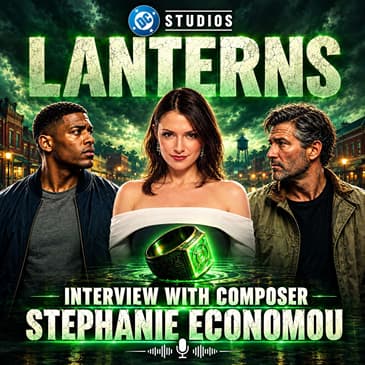
"Lanterns"
Composer: Stephanie Economou
Stephanie joins me to discuss her fresh and authentic score for "Lanterns". We discuss her process, how she approaches scoring, her mentor and everything in between.
Welcome,
Stephanie Economou
#lanterns #greenlantern #greenlanterns #johnstewart #haljordan #superman #dcomics #dcuniverse #sinestro #kylechandler #aaronpierre #jamesgunn #composer #moviemusic #moviescore #lanterncorps #dcstudios #hbomax
[00:00:07] What a unique score and congratulations. Awesome job. Thank you so much. I really appreciate that. Yeah, you know, it's effective. It's awesome to listen to. You know, I personally am partial to Away From Home. I like Away From Home, but An Alien World is the one I have on a kind of repeat. I love the whole thing. But I gotta say, Away From Home though, kind of unconventional for it to be on a score, right? Because it's a little more vocals than you're used to. Just talk about that. It's pretty interesting because I love movie scores. And that's something you don't see all the time.
[00:00:37] Yeah, Away From Home, it was... It came kind of naturally. I was not asked to write an original song for the series. Nobody needed that from me, but it was just kind of where... It was where I went creatively because there was this really arresting scene in Episode 5, you know, after the town of Brushville is basically destroyed.
[00:01:01] And, I don't know, I just heard... I heard vocals and I started writing some lyrics and that was the first place that I wrote it. And then eventually we took the lyrics out in the body of the episode, but I reprise it in the end credits with the actual lyrics. It was just... Emotionally, it's just kind of what I gravitated towards. And, you know, Chris Mundy was super open to just taking some big swings and that's where I came from. And I decided to expand it into a full-length song for this soundtrack. So I'm kind of going to be all over the place.
[00:01:29] So how do you get on board on such an awesome project? And is it in a way overwhelming because, I mean, this is a show everybody's watching. It's been... People have anticipated this show for months, if not more than that. So I guess that's a double question, but whatever you're ready to... Whatever's easiest for the answer first. I got hired on Lanterns through a really unusually straightforward demo process. Wow!
[00:01:58] Yeah, it's kind of rare that that happens because I didn't know Chris. I didn't know... I had never worked with HBO or DC or Warner Brothers Television before. So I was kind of a newbie coming into this. But I guess the story starts where Chris and Vix Patel, the editor, who have worked together for a very long time, they were very open to any composer choices and decided to listen to a bunch of reels of composers they didn't know. And some they probably did.
[00:02:27] Narrowed it down to a few who they shared some scenes from the pilot with. And we demoed, we actually scored a couple scenes from the pilot. From there, they whittled it down to another, a smaller group and met with us. And then from there, they hired me. So it's very... They did all of that blind. The first two stages of the kind of audition cycle, as it were, they did blind. They didn't know who wrote what. They didn't want to get attached to a person necessarily.
[00:02:56] They just wanted to be able to respond to the music. And that's a really rare way to get hired on something, honestly, because everybody comes in with their pre-existing relationships, which is really wonderful to continue your creative work with collaborative partners you've had in the past. But this was an opening. And for someone like me, who has a really diverse portfolio of work that I've done, very different scores and types of projects,
[00:03:21] this was such a dream for me to be able to just get my foot in the door and then kick it open as far as I could with the demos. Yeah, because I got to say, over 10 years, Stephanie, I've interviewed a million composers, and they've all been wonderful. And I have to say, I don't think I've ever heard with a project of this magnitude things being that wide open. That being said, your work spoke for itself. And this wasn't like a networking thing or, you know, hey, let's, you know, I'll start this, you finish it. This is all on your merit and credit. That's got to be the best feeling as a composer.
[00:03:50] It very much is. And I expect it to never happen again. And that's okay, too, because one is such a win. But it's, it's not always practical to hire somebody that way. Because even if they might like your music, it's maybe not a good fit on a personal level, or the ethos around your collaboration is different. But I met with Chris and Vix, and I felt like we just connected on a deeper level in how we approach the work and process.
[00:04:17] And I think the shoe fit and it wasn't so much that they were like, oh, cool, we like your demo. Let's give this a shot. When I started working, I made it clear to Chris, like, you know, we, I, the demo was the demo. I'm happy to start from square one and really get in there and find what the show needs. And he was just like, we love the demo, do what you did in the demo. Yeah. And just expand from there. You know, he was like, that's why we hired you. We hired you because you had a vision for it. And that felt really, really great.
[00:04:46] Really very rewarding to, to have experienced that. Well, you deserve it. And I'll tell you again, like, there's been two soundtracks I've been listening to on a loop since the summer. Well, this one more recently, Project Hail Mary, I love. So good. And it's like so talented. And then this one, I have it on a loop. I love it. It's just so unique. It's got that, that, you know, sometimes scores can sound like each other. This sounds like nothing else, which I love. But I mean that, I mean that in the best way possible.
[00:05:10] Like that's, you know, how much input or if any, does James Gunn have on any of this that you know of? So I, I never had any overlap with him in particular. I'm sure he had fed back on the score, but you know, it gets filtered down through multiple executives and then through Chris himself. So I am, I hope he likes the score. I hope he does. I, cause it was, it's, it's obviously a departure from a lot of, a lot of other DC projects.
[00:05:37] But yeah, for me personally as the composer, usually you're mainly dealing with a handful of executives and primarily your showrunner is your, is your point person for everything. So, you know, Chris and I had a good thing going and he really liked what I was doing. So that was sort of how we, we took it from, from there. Yeah. Yeah. That's, that's awesome. And let me ask you, so do you have to pre, so I know you said you saw the pilot, but do you have to preview the entire season? Because a few of your tracks are very specific.
[00:06:07] You know, Hal Jordan has his own track. Jon Stewart has his own track. And for fans of the show who are loving this score, you know, I read it online. Do you have to see the whole thing or can you just see enough where you've got, all right, I've got a taste for what Hal is. I got a taste for what John is and I can go from there. How's that work, Stephanie? I mean, composers mostly were scoring to picture. I mean, we have, with TV shows, it varies. You know, sometimes you get a couple episodes at a time.
[00:06:32] For Lanterns, they had pretty good cuts of most of the episodes when I got signed on to it. Okay. And that was, the benefit was that I was hired. They sent me all of the scripts. I read all of the scripts. And then I came in and we spotted the first couple episodes, which just basically means we sit down. We go through everything, listen to the temp score, talk about where they want music, talk about approach and emotion and pace and everything. And then from there, I'll just jump in and start scoring to picture.
[00:07:01] But more recently, with a lot of the projects I've done, I write theme suites away from picture. So I'm exploring palette and instrumentation and themes for characters. And Hal, that was one of the themes that I roughly was getting his swagger on screen that I pulled from the pilot and then wrote that piece away from picture.
[00:07:29] Same with the Lanterns theme, the main theme for the series. I wrote as a separate piece of music. It was the first thing that I wrote properly once I was hired because I wanted Chris to, I just wanted to gauge their temperature. I'm like, hey, what do you think of this? And they really liked it. And that was exciting. And Jon Stewart's theme is quite literally the first scene of the first episode. So I wrote that to picture.
[00:07:55] It was a great entry point for him as a character, like him as a kid, then flashing forward to him as an adult. So sometimes it's written away from picture. And you're just percolating on ideas and you're trying to get to the core of the character, keeping in mind where that character is going to evolve over the course of the season. And then other times you just kind of score it right to picture, you know, it varies.
[00:08:18] But I did have the benefit of reading all the scripts before I started and then getting to see a lot, like quite a few of the episodes. I would say half the season, like in the very early stages. Yeah. Yeah. Great answer. Stephanie, I'm sorry if this sounds very like non-educated, but when you say scoring to picture, that means you're watching it and then you're deciding what music fits best in a particular scene that you're viewing. Is that correct? Yeah.
[00:08:43] So that's a totally valid question because I realize it's such a thing that composers, we don't even think to explain. But I realize that some people don't know if you're not like sitting watching us. Right. So basically, when we're working on our rigs and mocking things up digitally and recording, we quite literally have the video in front of us. And when we hit play or hit record, it's chasing. It's like playing in real time.
[00:09:12] So we're actually literally scoring as it's going. That's the art of scoring really is reading a scene in real time. So it's less about like, oh, here's – I mean, sometimes it is. It's about here's my musical idea and how do I fit it to picture? It's very much about how can I make this music and tailor the music to what's happening on screen versus just trying to shoehorn your music into a scene.
[00:09:37] You know, that's about reading a picture and understanding it, finding the heartbeat of the scene. Stephanie, do you ever leave anything on the cutting room floor? Let's just say in this case it's lanterns because like you said, your filmography is very eclectic. I mean, you've done a lot. Do you ever leave anything on the cutting room floor? Like in this case, lanterns where you're like, I wish I put that in. I wish I put that in. Anything like that? You know, in every score that I've done, there's a lot of subtraction that happens.
[00:10:03] And with this project in particular, Chris and I talked about this very early on, how important silence is in this show and how I didn't want to wallpaper the whole show with music. But sometimes, you know, he wouldn't envision a scene having music and then I would say, listen, let me just try something because I hear it and then we can always take it out afterwards. It's easier to take away than to add at the last minute.
[00:10:29] So certainly there were some cues that I wrote that we decided like, oh, no, I think we like it dry or without that. There are other versions of their previous versions of cues or tracks that I wrote that I junked even before I showed it to anybody because I found a way. Sometimes that's the first step of writing a piece of music is writing something that's garbage and then you get to the other side of it and that's where the good stuff is. So there's always that on every single project.
[00:10:57] Sometimes it's their rewrites, but I have to say anytime I've rewritten a cue, I don't think there's ever been a time where the rewritten version wasn't better than my original idea. Oh, good. Good. It's a stepping stone to something better. You get more clarity and cohesion, I think, with your thought process sometimes when you have to take another stab at something. Talk to me and those listening about your rapport with Harry Gregson-Williams. Yeah, Harry was my mentor.
[00:11:26] I worked with him for six years as his additional composer and music assistant. He was responsible for my first job in the industry. I was in grad school at UCLA and he came and gave a master class and he was looking for an additional assistant at that time. And he liked me and listened to my music and hired me. And yeah, I was there for many years as his right hand. And I learned, God, I learned so much from him.
[00:11:57] He's a wonderful person to learn from because he's had a very diverse career. You know, we've worked on animation, documentary, action films, small indies. I feel like I really got to understand how to build the toolkit as a composer, working with him. Learned a lot about collaboration. Learned a lot about conducting and working with session musicians and orchestras. Yeah, he taught me a lot of a lot of what I know.
[00:12:25] And he gave me such great visibility, especially as an assistant. You know, as a young composer coming into the industry, you have people who you might work for who are not mentors to you, who don't necessarily care about your growth. And it's just a job. And that's cool, too. You know, you can't always expect somebody to want to foster that in you. But Harry very much did that. You know, he recognized that you need somebody in the industry to vouch for you.
[00:12:51] And help you build something and plant those seeds so that when you go out on your own, you, you know, can stand on your own two feet. Yeah, he's one of the greats. And let me ask you, you have a Martian credit, also one of the best scores. One of the best scores imaginable. Yeah. And it's maybe the best soundtrack in the last 20 years when you factor in the vocal music, how it was used, and the score, how it was used. Like, it's perfect. It's perfect. It really is. It really is.
[00:13:18] That was a funny, that was a really interesting score to work on and just film in general. Because I think every single person who was working on it knew how great it was. And everybody was such the perfect creative choice for what they were doing in every discipline. And it was like this neat and tidy bow. It was just like, this is all working. This is great. Everyone's going to love this. You know? It was fantastic. And I adore that score and I adore that movie. It's so, so wonderful. So I want to read for you a couple of Harry's entries in his filmography.
[00:13:46] And tell me a few that you're more partial to. Not that you like the best and the other ones you don't like. But I was just going through this list. Just tell me which ones that you're really partial to. I'll take the Martian out because you worked on it. But Man on Fire, The Equalizer, The Town, Gone Baby Gone, Kingdom of Heaven, which I think is his most underrated. A spy game, Shrek, Enemy of the State. Oh, Kingdom of Heaven stands out as just an epic, iconic piece of work, you know, on its own. I do love Gone Baby Gone.
[00:14:16] That theme is so hauntingly beautiful. Men on Fire. Oh, my God. So, such really stunning work in that. I like a lot of cues in spy game as well. And then, you know, the thematic work in Shrek is... I mean, come on. It's the pinnacle of wonderful, like, fantasy music. It's amazing what him and John Powell did. And Stephanie, none of his music sounds like...
[00:14:43] So, like, Kingdom of Heaven is nothing like Man on Fire, which is totally... They're totally original. If you were to listen to those, a lot of those, what I just named, you would think he was different composers for every one of those movies. Yeah. You know? So, it's pretty amazing. Yeah. Yeah. I think I took a lot of inspiration from his career into my own because I have a very eclectic taste in music and I'm very interested in a lot of different styles of music.
[00:15:06] And I think seeing Harry be able to flex in different directions and stretch here and go there inspired me to want to mimic that in my own career. I never want to have scores that sound the same, you know? I want to be able to confuse the hell out of people listening to, like, wait, that's the same person. You know, that's something that excites me. Yeah, yeah. That's great. That is awesome. Let me ask you this.
[00:15:31] Are there composers now that you've heard something recent, maybe within the last whatever, that you really appreciate, whether it's a show or a movie where you're like, wow, I love the way he or she did? Is there anything recently that you've heard that you've been partial to, I guess, Stephanie? Yeah. I would say last year, a score that I don't think got its flowers in the way that it should have was Daniel Lopatin's score to Marty Supreme. I thought that music was amazing.
[00:15:59] And I thought it did such an excellent job of immersing you in that world. And it felt so inherently tied to the story and the aesthetic of the film. I think it was so brilliant. And I wish it got more. I know that he got some nominations and things for that, but I thought that should have been up there winning Oscars, you know? Yeah. Yeah. Why do you think that is sometimes, Stephanie? Is it just personal taste from the voters? Like who?
[00:16:28] And are voters voting on soundtracks? So it's just, I guess it's, I'm confused by that because it's usually actors that vote for actor-like things. And I feel like who votes for the composers? Is it the same recipe? It's a similar recipe for a lot of these institutions. You know, for the Oscars you do have, especially in preliminary rounds, you have musicians and composers who are voting for that. And you have a short list for the Oscars.
[00:16:54] So, but I do think there's an element of, you know, voting for the names of the people whose scores you've loved for so long. And it doesn't necessarily matter if it's that composer's best score. It's just, oh, I love their work and they deserve to be celebrated on the big stage. So that gets nominated. But frankly, there are just so many brilliant scores out there and so few spots. But I will admit that I think that it is harder to break in when you're not, you've never been a nominee before.
[00:17:23] Or if you're just, yeah, like you've been building your career for a long time and you're starting to get higher profile projects. Or even not. I mean, you have composers who have been at it for so long who have never won an Oscar or do many retroactive Oscars. It's a strange thing, these awards, you know. But within the community, I think there's always a lot of talk about like, wow, that one really wowed me. That was so different. Who's this person that I've never met who like wrote this brilliant score?
[00:17:48] I mean, we're living in a time now where I'm really excited to see very diverse composers getting the credit that they so deserve. You know, people who are coming from totally different backgrounds, maybe not classically trained musicians, people who are coming from bands and all corners of the creative world. It's a very fun thing to see these scores getting more experimental, more rule breaking.
[00:18:16] To your point, Stephanie, Thomas Newman is 0 for 17. That's who I was thinking of when I said that. Yeah, yeah, yeah. That is beyond explanation. Like, I'm sorry, you can't justify it. He's like, in any other field, he'd be the top three of whatever. Like, it's insane. But there's also things like, so Interstellar, you can make the point that Hans Zimmer has called it his best work. And there's always clips on TikTok of people playing the cornfield, you know, the cornfield chase.
[00:18:45] But like, that lost out to Grand Budapest Hotel. Listen, that's a great soundtrack. But I don't get it. Like, it's just, that's why you can't get too ripped up in awards. It's more, I guess, appreciating the process, appreciating the product, as you mentioned with Marty Supreme, which is a phenomenal score. Yeah, I agree with that. Yeah, I agree, too. And I also think Interstellar is Hans' best score. It is. And I just, we went to a concert of his, Stephanie. It was so amazing. Like, I tell you, in a car, nothing hits. Like, I had Lanterns playing today.
[00:19:15] Nothing hits like a movie score. It sounds better than vocal music. It sounds better. It just hits. It's clear. It makes you reminisce about the show. You're thinking. So, I don't know. It's just, I love movie scores. I have since I was young. And it hasn't left me yet, Stephanie. Good. I'm glad. Yeah. Thanks for listening, all composers. Thank you. So, let me ask you this. Just a couple plot points.
[00:19:39] I don't think Hal Jordan, I don't know how much you've seen, but I don't think Hal Jordan is as bad as everybody makes him out to me because I feel like fan feedback is like, he's selfish. The whole town hates him. But he strikes me as a, have you seen the Harry Potter series? Maybe a stupid question. But he reminds me very much of Snake where I feel like the lot of good he's doing we haven't seen yet. And he has to kind of take it and take it and take it knowing full well he's doing good underneath it all. Maybe I'm wrong with that statement. But I just, I love these characters, Stephanie.
[00:20:08] And they must have given you so much, so much to write about. And just talk about the story itself. What are you drawn to? What do you love about it? I love the characters too. And I agree with you. I mean, I think the dynamics are interesting and what they've chosen to delve into, especially in the complicated time of Hal and John's relationship.
[00:20:33] I do think that, you know, we see Hal painted in a certain way. And I think it's mostly through the lens of John. And I think that's sort of what it's about.
[00:20:46] Because we see, you know, in the last couple episodes, we saw John coming to the diner and seeing Hal in the 2026 timeline and saying, you know, you did time in prison for all of the shit that went wrong. And Hal's like, you know, there were two of us that did that. And it's so true. And Hal was kind of put into an unfortunate situation with all of that, too.
[00:21:12] There's two sides to, I think, that situation of what happened in Rushville. But he can be quite a selfless person. He can also be quite selfish. But so can John, you know. And I think John just sees this guy who was supposed to train him and teach him who didn't. And he got kind of impatient with that. And then Hal, on multiple occasions, tried to kill John, which, I mean, frankly, that's what it is. So I understand why John's pissed about that.
[00:21:41] He's like, what is going on with this? You know, the Guardians chose me to do this. He won't accept it. I'm his replacement. He doesn't want to, you know, he's stubborn. But it doesn't mean he's a bad dude. You know, there's so much good in Hal. And I became very interested in all of those dynamics throughout the season. I was very interested in these space cops coming into Rushville, into their lives, and how they were, like John and Hal, were so hated by everybody there,
[00:22:10] and how they see the events that happened that destroyed their town and killed their people as they were made collateral damage in this situation. And that's honestly what inspired me to write Away From Home. That's why I decided not to write a song for the Green Lantern Corps or for the lanterns themselves. I was interested in what is this balance between these people with such cosmic force
[00:22:37] that come in and affect humans in this way. But the blame is on both sides. That's what's so interesting about it. And there are so many sacrifices that lanterns also make that people of Rushville don't see. They don't see that they're really trying to protect them from this greater evil that they have kind of succumbed to. They've become manipulated by Zoe as a manhunter. And I just found that really fascinating, is how the lanterns exist on Earth with normal people
[00:23:07] and the responsibility that they carry every day. Yeah, it's so great. That's a great answer because, you know, the people in town haven't seen what would have happened had Hal not intervened. Yes, it was collateral damage. Yes, to your point. Awesome. Yeah, I totally agree with that. I have to say, Kyle Chandler is the best casting of a superhero since Robert Downey Jr. in Iron Man. He's so good. He's so good. But maybe that's the thing. Like, he wasn't, like, he's just a great actor who,
[00:23:34] this role is just, he fits it like a glove. Yeah. Yeah. Sometimes it just works that way. It's such excellent casting. And so is Aaron Pierre as John, too, because I love how measured and steady he is, but he's got this fire, you know, burning underneath the surface. And I used, I very much used his characteristics and his theme. I wanted something that was very dedicated and precise. And that's why, you know, the riff that I wrote for him on this baritone rubber bridge guitar
[00:24:04] is so steady versus, and it's more grunge, right? It's more grunge influenced. And then Hal's theme is more like blues garage rock. It's unruly. It has attitude. It's got swagger. It's syncopated and off. You know, I recorded, like, empty beer bottles and scrap metal and wood and, like, really, really rugged percussion for him. You know, that's Hal. And John is very lonely, but very, you know,
[00:24:31] precise in everything that he does, you know, as a sniper and in his training and also as an architect and an artist. So that was, I very much tried to immerse myself in who these characters were and try to let the music speak through that. Yeah. It's almost like wrestling in the sense that wrestlers have their own theme. The way you, like, when I hear your music, I'm like, Hal, John, like, I love that. Like, that's just so great. So when you were, I read an interview, like, when you were younger, what was the rock music that was playing in your house?
[00:25:01] Who were the bands? What were the songs? Yeah. There was a lot of Pink Floyd and CCR and Fleetwood Mac, Alice in Chains, Alice Cooper. You know, it spanned Nirvana. It spanned quite a few decades. That was the soundtrack to my life. And then, you know, once I got old enough to start developing my own taste in music, I really got into classic rock.
[00:25:30] You know, Pink Floyd, I would say, is still one of my favorite, is probably my favorite band of all time. So that definitely stuck with me. But, you know, started discovering other things. And, you know, Radiohead and Mark Lonegan had a really massive influence on this score, as well as, you know, some other 90s and 2000s rock bands, too. But yeah, certainly, like, my parents' record collection was anchored in a lot of 70s rock.
[00:26:00] And, you know, as a kid growing up in the 90s, I took that and then was like, oh, what's Blink-182? What's Punk? What's all of this? What's the system of a down? What's, you know, like, leaning in all sorts of other directions? And I think that eclecticism has fed through how I like to write music and incorporate different stylistic influence. Do you listen to vinyls still? Yeah. Wow. Does vinyl... So, Stephanie, explain the appeal of vinyl. Does it come out better? Is it nostalgia? Is it both?
[00:26:29] Is it the best way to listen to music? Just explain that to me, because sometimes I'm not sure why people do that other than nostalgia. I personally like it as a physical way of supporting artists, frankly. Definitely. And then slowing down and taking time to intentionally listen to music instead of... You have to try to open a record and take care of them and put it on
[00:26:57] and flip it to the other side. And I like the ritual of going through and discovering what I have in a physical way and saying, like, oh, let's do this. Oh, and then I have this idea to go next. And listening through an album from start to finish, I think, is kind of an art that's been lost that I think a lot of people miss just sitting down and listening to a record. And, you know, sometimes I'll do other things at the same time. My husband and I will play cards and put records on and just spend nights doing that.
[00:27:27] And it's... Yeah, I think it's a great way to support an artist, but also it's the way that I prefer to hear things because it forces me to slow down and really appreciate an album for what it is. Yeah, that's a great answer. And you've had some of those hard rock guys make their way into, like, composing music, right? Who's the... Of course, I'm going to forget their names, but who's the... There's two of them that are very famous that have made their way over to composition. Do you... I totally forgot the name. I think you're probably referring to the Nine Inch Nails guys,
[00:27:57] Trent Ruslan and Atticus Ross. Yes, there you go. Yeah, yeah. Some of my favorite composers and musicians as well. Yeah, I would say that this score is heavily influenced by Nine Inch Nails too. Yeah, yeah. Here's some of that. And, you know, thank you for saving me on that, by the way. And I have to say, Book of Eli. I mean, those guys, I mean, it's just insane. Stephanie, so I hope this opens up more doors for you. And are you getting...
[00:28:27] Is it too early to tell that you... It might, like... Because, I mean, I shouldn't say open doors because you've been doing this successfully for a while, but open more doors, I should say. Do you feel like that's something that could arise from this? I mean, you always hope so. Yeah. I just feel really grateful to have worked with Chris and these studios because they gave me so much creative freedom to try things and go in an unexpected place. So I hope to continue to work with them if I can. But, you know,
[00:28:56] the reality of getting to score a show that ends up being quite successful like Lanterns has is that it's like, oh, the phone's ringing, the phone's ringing, there's so many offers, but that's not always the case. You know, I do hope that... I mean, the greatest hope that I have from this is that I've shown another side of myself as a composer that is really quite important to me, you know, with this rock music that is so defining for who I am.
[00:29:23] And I hope that attracts future collaborators that respond to that and who also like using that as the storytelling, you know, a way of telling their story musically. So, you know, we'll see. I hope it does, but even if it doesn't, this has been such a fulfilling experience for me and I hope we get to do more. Well, you know what's great, Stephanie? This will be the last thing I say is that you're super authentic and that has led to an awesome score. Like, you didn't become somebody else to make this, make people happy and make this.
[00:29:51] You kind of were yourself this whole time. You brought your vision into this stuff that you've been doing for years that have molded you into this great composer. I don't know, it's kind of refreshing to see and hear when I'm listening to it. So that's great. Thank you. That means a lot. Yeah. Thank you so much. Do you want to throw any social media, anything like that, Stephanie? Yes. I only have the Instagrams. I am at Steffi Konomu on Instagram and same thing on YouTube. If you want to follow my YouTube channel or where myself and Water Tower Music, the record label,
[00:30:20] are releasing singles every week and the full soundtrack drops on October 4th with the season finale. I lied. That's my last question. So I was listening to the score and I couldn't figure that out. I'm like, there's no way this thing just has eight tracks on or whatever. It was like eight or nine, something like that. So how many is the full, what's the full number? Are you able to say? That's a great question. I can tell you right now. Yeah. So we decided to, it was my idea to release a single with every episode on each Sunday
[00:30:49] so that it ties to the episode thematically because- I like that. I feel like there isn't enough of a, like a hoopla around soundtracks anymore. And for a show like this where it's releasing weekly, it's like, it doesn't make sense to just release the whole soundtrack with the finale. It's like, then it's gonna, nobody's gonna listen to it. You know, it's nice to make more of an event of releasing music. I think that isn't done as much as it should be done. So that's been a really fun thing to do. But the full soundtrack
[00:31:18] has 24 tracks total. Nice. Nice. Good. Good. You know, because yeah, it's in, I thought for a second that you might not be doing, you might not be doing that because of sometimes composers put not intentionally spoilers in the track name. Like you're saying. I am so careful with that. Yeah. John dies or like, yeah. So, you know, but Stephanie, I'm a huge fan and I cannot wait for what the future brings to you. You are so gifted and talented and thank you for this time. I really appreciate it. Thank you so much, Darek.
[00:31:47] That means so much to me. Thank you. Thank you. Thank you. Thank you.