
Episode 624
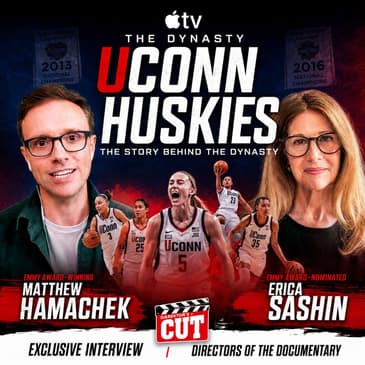
Directors: Matthew Hamachek and Erica Sashin | “The Dynasty: UConn Huskies”
Directed by Emmy Award-winning Matthew Hamachek and Emmy Award-nominated Erica Sashin, the series combines rare archival footage, intimate interviews, and behind-the-scenes access to UConn’s 2024–25 championship season. It features all-new interviews with basketball greats Sue Bird, Paige Bueckers, Swin Cash, Azzi Fudd, Rebecca Lobo, Maya Moore, Jennifer Rizzotti, Breanna Stewart, Diana Taurasi, and more.
Premiering globally on Apple TV this Friday, August 21, 2026, “The Dynasty: UConn Huskies” is a three-part documentary series chronicling 40 years of the most dominant program in women’s college basketball. Under Hall of Fame head coach Geno Auriemma, the University of Connecticut Huskies have won more NCAA Division I basketball national championships than any other program, men’s or women’s, and have produced generations of players who have helped redefine the sport.
Welcome, Matthew and Erica!
Instagram: / mondaymorningcritic
Facebook: / darektorscut
TikTok: / mondaymorningcritic
darektorscut@gmail.com
darektorscut.com
[00:00:07] Darek Thomas, Darektor's Cut. Matthew, great to speak to you again. Erica, nice to meet you. Nice to meet you. Nice to meet you. And I have to say that, you know, Matthew, I was skewered by the New England faithful for not giving you more of a hard time for that documentary, but I stand behind our interview. I think it was awesome. I do not believe it was a hit piece. I think it was great. And I enjoyed it. I stand behind it. But I live in the heart of New England and I felt like I did something wrong and I know I didn't. No, and I'm never going to fault anybody for taking it easy on me. So thank you.
[00:00:36] Yeah. Let me ask you this. So when it comes to similarities, speaking of the Patriots, any similarities between Bill Belichick and Gino? Do you see any there? Either of you? Yeah, they're both incredible coaches in terms of the X's and O's of their sports, right? But then I think what their true talent is, is getting greatness out of their players.
[00:01:03] And, you know, I think that there are a ton of similarities between the two of them. Erica? I'm going to leave this one to Matt. Okay. He's the expert. So let me ask you this. Were you caught off guard by the squeaky shoes? Because I felt so bad for you. I was like, I don't know how I would handle this. I felt like you kind of incurred a little of his wrath at that point.
[00:01:30] I don't get bothered by that kind of stuff. I actually love it. I think also, you know, Erica had been going through the footage at one point and said, hey, you should really look at it. We should look at this again and think about putting this into the cut.
[00:01:46] And I think that, you know, it really gives people a sense of Gino is just like this. This is who he is as a human being. And it's not just how he treats the players. It's not just how he treats his coaching staff, but it's how he interacts with everybody in his life.
[00:02:10] And so it's a great moment. And it also, I love that it ends with him saying, you know, why would I say if it wasn't true? Because it's just such a great way for a subject of a documentary to sort of introduce himself to the audience. Genius to put that in. I'm so happy you left that in because that everything you said. Yeah, Erica, that was such a smart decision. I mean, it does. It gives us a little bit of a glimpse into the man.
[00:02:34] Yeah, I loved that moment. It was so off the cuff, but so revealing. And I was grateful that Matt was he didn't bat an eye at that, you know, it's great sport. It has me terrified for my interview with him in about 10 minutes. But anyways, let me ask you this. So I love the doc. I did. One question I was dying, I'm dying to ask you both is why not more on Chris Daly? Obviously, she's there the whole time.
[00:03:00] I mean, this is his first lieutenant the entire time she's been there. I mean, there's only so much you can put in a doc. I get that, too. I mean, but just her just thoughts on her, guys, whatever you have to say. She's incredible. She's like, you know, a major factor in terms of why that program has succeeded.
[00:03:18] I think, you know, the tricky part in making these things is you have three episodes to cover 40 years and you have to make sure that you, you know, pick and choose which characters you're going to highlight. And, you know, if we didn't do if we if we did more about Chris, we probably wouldn't have been able to do Diana.
[00:03:39] And so it's this it's this question of how much time do you spend with the coaching staff versus how much time you spend with the players and each generation that comes in. And when you think about the the amount of players that were so important to the program that we didn't we didn't cover, you know, it's just it's just part of the process. Got you. So I have to ask you this as well. How did your perspectives change on him or today at all?
[00:04:09] I mean, from start to finish, did your your thoughts on him change or was it kind of the same all the way through? Again, either one of you. For me, the more I learned about Gino, the more interesting he was. He's just he's there. There's so much to him, you know, from his upbringing, coming to the U.S., from Italy as a young boy, not speaking English, wanting to prove himself.
[00:04:35] I mean, you see that little boy in him now, you know, and still like wanting to prove himself and never feeling like he's, you know, done it, won it. If he wins, he's got to win again.
[00:04:49] So I think, you know, I just I found him the psychology of Gino incredibly fascinating and also the way he was able to really look at each individual player and figure out what he needed to do to help make them the best version of them. He's just incredible at that.
[00:05:17] And that just takes like a lot of emotional intelligence, I think, to be able to understand people as well as he does. Matthew, you agree? Yeah, absolutely. I think, you know, I think of Gino as a character that you could not write in a fiction screenplay.
[00:05:44] His relationship with winning, you know, we begin the second episode with him talking about how he was on a high like he'd never been to before after he won his first championship. And then by you, you go into his backstory and that Erica was talking about, and then you learn about his relationship with Pat Summitt and sort of what she and Tennessee brought out of him and pushed him to become.
[00:06:07] And then by the end of that episode, when he's won his 11th and then he gets beat by Mississippi State, you know, he's already talking about how he's numb to winning at that point. It doesn't mean what it did. And then to see that same person go through a nine year drought and then have the emotion that he had when they when Paige got the and the team got the trophy in 2025.
[00:06:35] It's just like I said, it's a journey that I don't think you could script and have it be believable. So when you get to sort of meet these characters and we interviewed him for 15 hours, I think over the course of multiple interviews, you just the complexity of these people and sort of finding out what makes them.
[00:06:57] Human and ordinary, despite the fact that they're going through such extraordinary things on the biggest stages is endlessly fascinating. I think it's what we both were always sort of searching for. And I think that goes back to your early question about how do you decide what to put in and whatnot. I think when you can find characters that you think can relate to everybody who's watching, whether they like sports, basketball, they hate sports, whatever.
[00:07:25] You know, it's like when you look behind you at all those movie posters you have up there, all of those characters are going through something that's extraordinary. But you can relate to them because their emotions and what they're going through is very ordinary. Yeah, great answer. Both of you. I have to say one of the more stunning moments for me is so he has Rebecca Lobo there, right? This is the turning piece of his entire career, his program. She gets the ball rolling and she goes to see him.
[00:07:54] And I'm saying this because when people see this, I'm dying for them to hear your answer. She goes into the office because there's a chemistry issue. He basically tells her what she needs to do to get to the status that she wants to achieve. Two days later, she messes up at practice. He says, you see that? She has the effing nerve to come into my office and be upset. She's going to pull this shit to that, basically.
[00:08:20] And I have to say, the fact that he has this five-chip star player that he's never had before, and he goes through with that, most coaches would be scared to say that. Do you see what I'm saying? His future is in the balance, and he lets her have it and embarrasses her in front of the team. Most people would have backed off of that. I was stunned that he went through that. What's your take on that?
[00:08:44] I mean, you see this with player after player, actually, where he finds that line of how far to push. And he takes some risks. But I think he also inherently knows how far. Paige said the same thing. Paige said, like, you know, I almost quit. And Gino said, you know, with Paige, like, I took a risk. You know, like, and he did that with Rebecca.
[00:09:11] I think he is really good at pushing to the limit, but not over, right? Because so many of these players at different times, I think, almost were put over the edge. But he didn't go all the way. I think it's an incredible skill that he has, actually. I think it's very premeditated.
[00:09:40] Because the Paige stuff is kind of hard to watch. Because I always thought, you know, they have this playful rapport. She's kind of goofy. She slaps him on the ass. I had no idea how serious this was. Like, I mean, this is a really hard part of the doc to watch. And I have no question, when this drops, they'll be talking about this, especially the Paige part. I didn't know how emotional and contentious that got. Yeah, I think that was similar for us.
[00:10:05] I don't think, you know, we really had to sit and listen to all of the people who were involved. And then you get a little nugget of the fact that things were more serious than what anybody realized. Not only, you know, obviously us as non-UConn fans. But, you know, I think everybody that was covering the team had no idea that it had gotten that leak.
[00:10:32] And didn't really understand quite how much Paige had gone through. And I think that it wasn't until we were able to actually talk to Paige and ask her about it that we understood the sort of depth of it. But at the end of that interview, we were asking Paige, like, you know, this was a really brutal interview. So even just to watch the, I mean, I think part of what you're talking about here is the expressions on her face. Yes. When she's talking about finally winning.
[00:11:00] But also, like, I mean, even like the way she breathed when she's talking about the panic attacks she would have at night from the, from her injury, from her, from her second injury, I believe. She's from her ACL tear. You know, we were talking to her and we were saying, like, well, why did you go through this? Why were you so forthright and honest about this?
[00:11:25] And she was just talking about how kids that are watching just sort of see the trophies and the confetti falling and they think like, oh, okay, like, I can do that too. Everybody wants to be great at whatever they're doing. Sort of the question is, are you willing to put in what it takes to get there? And I think that that's what she said to us is that that's what she wanted to show people is that it takes a lot to get to this place and you have to really put yourself through all of this.
[00:11:53] And I think that that's what makes this story so universal and something that anybody can relate to, whether they like basketball or not. We all have these things we aspire to do and to accomplish. And, you know, a lot of time it comes down to what you're willing to put into it. Yeah. I'll tell you who I love that you had in this. There's two people, but the first one, I love Sally Jenkins.
[00:12:19] When she gives her input, it's so emotional. It's so sincere. And she fills in some gaps, obviously, because Pat is not with us anymore, but she fills in some gaps that the viewer needs to hear and needs to see. And she's emotional and very real about it. I don't know how you guys feel. I loved her. I thought she was an MVP, one of the MVPs and a secret sauce in this talk. Yeah, I think we loved her too. She was a later get for us.
[00:12:45] It took a long time just with her schedule, but she was so close to Pat and just so knowledgeable and smart. Yeah, she was wonderful. And the other of which is Jackie McMullen, who is like a top three all-time writer and one of the biggest trailblazers in the history of basketball, you know, women's sports, sports in general. She's an MVP get too.
[00:13:12] I think what they both do that's so great is that they ignore the – it's not like you're sitting around listening to them talk about like, and then this person scored 22 points in this game and they had like, you know, two assists and da-da-da-da-da-da. They are great human storytellers.
[00:13:29] And, you know, it's what Eric and I were aspiring to be like when we were making this and sort of all of our projects, right, is, you know, you could look at it and say like, oh, okay, well, they don't know anything about UConn. They don't really care about the team. Why are these guys making a UConn documentary?
[00:13:48] But I think the answer is that that sort of perspective allows you to focus on the things that are really important, which is what makes these stories human and relatable to people no matter what they do and no matter whether they care about basketball or not. And I think that that's really important. But that's what makes Jackie, you know, and Sally so great at their job is that they focus on the things that are really important.
[00:14:18] Yeah. I'll end with this. I have to say, you know, there's a quote by Diana Taurasi. She says, it just ends, talking about his career. I have to say, I feel like winning doesn't impact him. Like, it's a numbing thing at this point. He doesn't get the full value of it like I think he used to. How does this end for Gino? Just your personal opinions. I know you don't have a crystal ball, but I think he loves this. I think this is the only life he wants to live. And he should. Coach, as long as you want. But how do you think this ends for him?
[00:14:46] And I think that's the biggest question mark of the doc, one of them. What happened? How do you foresee his future? It's up to him. I don't know. I mean, you know, it was interesting that we caught that moment at the end where he tells Chris Daly, yes, I'm going to retire. And, you know, of course, we had a lot of questions about that. But he wasn't ready. He's not ready. So he's going to have to write his own ending, whatever that's going to be. Matthew?
[00:15:16] You know, you were talking about the New England thing. I think a lot of people ask themselves the same question when Tom won the Super Bowl with Tampa Bay. And they were saying, like, oh, come on. Like, you just want you can't. There's no greater walk off into the sunset moment than this. Right. But that's like viewing it.
[00:15:36] That's sort of it's viewing people that accomplish things that like at a rate and a clip that we can't possibly fathom. We have to, you know, in understanding what it took them to get there. And then at the last moment to say, hey, now I want you to behave like a normal person and realize the scope of what you've accomplished and just walk off into the sunset. It's sort of silly on our part. Right. Right.
[00:16:00] It's like, why would we expect them to behave like us the way we sort of see the world and the way that it should function at that moment? And I think that Gino's, you know, always going to be a little bit of that kid on the playground who didn't speak English and has to prove himself no matter how many championships he has. And I don't think that that. I think that when he says he's numb to the winning, he's being honest.
[00:16:27] I think that the that sort of that insecurity or whatever you want to call it that he had from a very young age is the thing that sort of keeps him coming back over and over again. And who knows if he'll he'll ever sort of extinguish that or whatever you want to call it. Great answer. Matthew, Erica, terrific job. Awesome, Doc. Can't wait for people to see it. Thanks. Thank you. Yeah. Bye bye.