
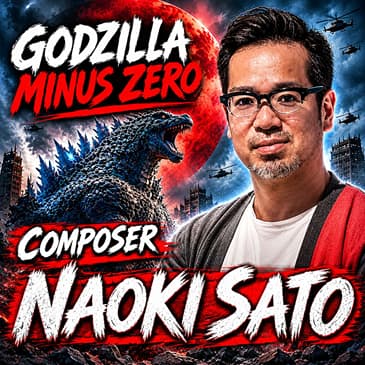
Episode 634
Naoki Sato | Composer
Godzilla Minus One and Zero
In this episode of Darektor's Cut, host Darek Thomas sits down with acclaimed composer Naoki Sato to dive deep into his haunting, powerful scores for Godzilla Minus One and Godzilla Minus Zero. Sato shares his creative process for balancing raw emotional despair with epic kaiju spectacle, explaining how he honored Akira Ifukube’s iconic legacy while building a distinct musical identity for a modern era.
The conversation also explores Godzilla's extraordinary 75-year cultural legacy—examining how the King of the Monsters has evolved from a stark post-war metaphor into a global cinematic icon that continues to captivate audiences around the world.
darektorscut.com
#godzilla #godzillavskong #godzillaminusone #godzillaminuszero #naokisato #japan #godzilla2026 #godzillaactionfigures #godzillamusic #godzillamovie #godzillamovies #godzillaxmothra #godzillakingofthemonsters #godzillaxkongthenewempire
Instagram: https://www.instagram.com/mondaymorningcritic/
Facebook: https://www.facebook.com/darektorscut
TikTok: https://www.tiktok.com/@mondaymorningcritic
darektorscut@gmail.com
darektorscut.com
Instagram: https://www.instagram.com/mondaymorningcritic/
Facebook: https://www.facebook.com/darektorscut
TikTok: https://www.tiktok.com/@mondaymorningcritic
darektorscut@gmail.com
darektorscut.com
[00:00:53] Naoki, it's very nice to finally speak with you. It's been a long time that I've wanted to speak with you, so thank you for your time tonight. Thank you. So I have to say, your creation here in this beautiful world of Godzilla, this score is as good as anything by Williams, Newman, or Zimmer.
[00:01:16] I think the world of the score, when I first heard it three years ago, I couldn't believe what I was listening to. Amazing. Thank you. I was like, I was like, I'm a fan of the world of the score. I was like, I'm a fan of the world of the score. I'm a fan of the movie, so I'm like, I'm a fan of the movie.
[00:01:48] It might be a little bit overstepping of me to feel that my name could be listed in that same list you just gave. Because, I mean, they are my huge inspiration for movie composing. Yeah, absolutely. Well, Naoki, I'm going to tell you right now, my ears don't lie, and I know what I hear, and you are a genius with music composition. Thank you. Thanks so much.
[00:02:15] Naoki, when do you realize that you have something special? Because I listen to a lot of film music, a lot of movie scores. When do you realize that this is a very special soundtrack? This is a very special world you've created with this music. That just makes this movie just fly along and drives it along. It's just so well done.
[00:02:46] Thank you. So, Dan said that he was a character that was a character that was called Godzilla. That's why Dan said that he was a character that was a character that was a character that was a character.
[00:03:17] I didn't have any questions. I'll give you a question. First off, I want to say I'm not special by any means. There are many composers like me in Japan. And I think why we are having this conversation together is because I got really lucky with the projects that have come my way. And I've worked with Yamazaki for a very long time.
[00:03:41] And he happened to be doing his take on Godzilla and reached out to me to score the film for him. So, I think it was just coincidence and happenstance that I was able to work on a film that allowed me to showcase my work. And a film that had so much worldwide market penetration that people happen to listen to what I do. But I will say there are a lot of talented composers in Japan with skill comparable to mine.
[00:04:10] And I think you missed the question. I think he looked at a different translation. So, I'll get the question that you actually asked him. Okay.
[00:04:19] So, let me ask you some questions.
[00:05:11] What do you think about it? I don't think it's a good music. I don't think it's a good music. And I think it's a good approach to this movie. I always doubt and regret it.
[00:05:43] I give it 120, 150%. I try to complement whatever imagery is on screen at any given moment to the maximum of my ability at that time. But there's always this nagging feeling that some better music, something more appropriate exists. Maybe there was a better approach to do more service to this imagery on screen. I always have that feeling. And I've worked my entire career with that whispering in my hair.
[00:06:14] To add to your point, I feel like you didn't do this with an assistant, with no orchestrator. You put in many hours. That had to make it so much more difficult than composers that have access to those options. I think there's a lot of challenges in the environment. I think there's a lot of challenges in the environment. I think there's a lot of challenges in the environment. Why do you know?
[00:06:43] Orchestrator, Assistant, Programmer. John is your own. Yes. I think it's cool. I know. I know. I know. I have to say, well, you know, I don't know if it's a good song. What, I don't know if you are. I don't know. I don't know. I don't know. I don't know. I can't.
[00:07:37] I'm very impressed that you knew I don't have an orchestra I don't have an assistant I don't have a programmer so I do all of those processes by myself what I will say this process unlocks however is a very high concentration of my own musical expression because literally it's just myself doing all the different arrangements and processes so from the very first note and I actually handwrite my sheet music
[00:08:06] so I think it's a very raw and honest expression and sort of interface in which I take what I hear and put it into another form that people can hand off to each other and it's how I've done it my whole career and I think it's what allows me to compose the type of music that I do again going back to that high concentration
[00:08:58] And as you mentioned, doing all of those different disciplines as an individual is extremely hard work. But more so than that, I think it allows me to go down the path that I believe and I trust. And again, I'm never fully satisfied with anything or most of the things I've done in my career. But the idea that I can chase it alone, I think, is what helps drive me to compose this type of music.
[00:09:27] Your score is nothing short of stunning. Your original compositions are suspenseful, heroic, epic. Renditions of Akira, if Kubay, is fresh, yet it still honors his work. You brought out the original Kong theme in a cinematic fight in the first movie, which was so clever and so well done. I have to ask you, how did you find the balance? In some ways, I felt like you honored him.
[00:09:56] In other ways, you made it fresh. It's just so beautiful to hear. How do you find that balance? How do you find that balance, Naki? Like, balance is yes. That's right. I've heard of Kimbé, I've been both in a studio. I've been able to watch Godzilla, I've ever seen it. Maybe Godzilla, I've been able to experience the best of it with this kind of amazing performance. I feel like that's a lot of physical performance. I've been able to keep it, so I've been able to keep it.
[00:10:21] Do you know how much respect, homage, I've been able to see you and what I've seen in front of it? I've been able to watch your music, and I've been able to see you as a few of my career. The first thing I thought was that I was going to be a Godzilla theme. The music was Godzilla's character in the beginning of the game, and the music was very important.
[00:10:46] The music was going to be Godzilla's character in the world. So I thought I'd be able to make it so that I was able to make it. So I thought I'd like to make it so I was able to make it so I could make it easier.
[00:11:21] I'm not sure what I'm thinking about. the music and the most interesting music, the most interesting music, that was the one that was asked to. Ifkwe先生's music is an icon, it's not a good thing to play with other songs.
[00:11:47] It's a strong item that can be used to be able to get to it. I think it's a powerful item.
[00:12:21] Hello world setting. It all comes to life. So my job then becomes compose everything else. But still knowing that I had that safety net is a huge load off of my shoulders. So in terms of the balance that you said, for me, it wasn't so much balance. And I don't think too hard about, oh, I got to pay homage to this and then look at the history. And then I got to make something fresh.
[00:12:47] I didn't try to get caught up in that sort of mind mindset. What I thought of the most and the biggest hints for me was whatever visual image Yamazaki put on the screen. So I got the rough cut. I would look at that and think, OK, this is what I hear. This is what the sound. This is what this image sounds like to me, as well as the screenplay. So those two were my biggest pillars of what I relied on to create that sound.
[00:13:17] And I think that really helps define the sonic signature or the direction of the overall movie. And what you see was the result of that mindset of focusing on the imagery and the screenplay. Now, using Ifukube's original Godzilla theme, I think because it's so iconic, it elevated the entire soundtrack.
[00:13:41] Like having that soundtrack among the rest really elevates the entire movie score, which I benefited from for sure. So I have to say, in the first movie, it functions as a character study of Shikishima dealing with survivor's guilt. How do you translate his internal psychological struggle and trauma into musical motifs before Godzilla even takes the stage? It's almost like two different stories.
[00:14:09] And once they get together, it's bliss. It's beautiful. It's just wonderful to see on screen. Yeah. Minus One is very, Shikishima's trauma. The loss of that, like, job or work or not to take the pain of the scene of Godzilla. When I see that, Godzilla takes the time of the observations of Godzilla's elements. The sound of it is perfect. So we have Godzilla and the combination of the two-fold
[00:14:38] and the harmony of the taste. How can we do that? How can we do that? What can we do that? What can we do that? How can we do that? The Troumah from the beginning, the Troumah from the beginning,
[00:15:06] he was a little bit nervous. He was able to do the next to him. The Troumah from the beginning, the GOLJILA was a bit of a parallel, but he was a bit of a different kind of rhythm. He was able to do it on the beginning of his own music. So I did it with harmony.
[00:15:33] I was able to do the harmony. I was able to do harmony with a lot of the words. I was able to do the melody. I was able to do the way to do the work. I was able to do the strings. Strings is turning the tuning into the tuning. Strings is not a good thing to do with the tuning. He's showing his face.
[00:16:04] Does this answer have to be? Yes, it is. character is constantly walking around with a sense of nervous tension. And it is a his mental
[00:16:29] labyrinth is about, well, how do I find my path towards redemption? So you're right, there are two stories. There's the Godzilla story. And then there's a Shikishima story that we're following. So whenever I would look at Shikishima's side of the story, I would intentionally make extremely complex harmonies, so complex to the point where they almost break. And there's no real melody per se
[00:16:53] that audiences can anchor themselves to. So that was how I created that very eerie Shikishima mental state vibe. And also a lot of the strings that would offset them from when people would normally expect to hear a string. And that was how I think we evoke the Shikishima's mental state. And then how I translate it to something that we can interface with as, you know, an audio. the audio. Yeah, yeah.
[00:17:24] anakwriting as well as you might as well, then use thewideuneaudible deck, and then give it up on Turn saw that Eye-Each placement Chelese for this. And AC is sister whose way youriah- gusto is Yeah, it is so square. Dick and I play grows to learn looks that super fast activities with as someone else could get 10 minutes is Thank you for course, goodbye. Yup, thoughts themselves to is six times of the duo on stage MO' Whatever about I love to trade these works. There's a joyful reaction from the Twenty-motion through me okay beforeic test
[00:17:51] That's when I'm going to play a song with the song.
[00:18:21] I think there's a balance that becomes a theme of Shikishima.
[00:18:51] I just sort of hummed for you right now. We go from this very unstable Jenga piece where one blow of the wind could knock everything over to something that it's the same phrase that's echoed over and over, but there's something heroic about it. And it's not an easy song to listen to, but I think it gives some sort of it really shows that determination and the change we see in Shikishima's character.
[00:19:21] Oh, that's a great answer. I have to say, and the reason I add to it, because in some ways it almost seems like, they both seem like two movies, right? Especially the first one, where it seems like Godzilla's one factor, but its humanity represents the other. When scoring a creature that represents sheer destruction and despair, how do you calibrate the score to keep the movie grounded in human hope without destroying that horror that comes with Godzilla?
[00:19:49] What's the thing about Godzilla?
[00:20:20] This is actually a joke about Godzilla minus one. So you're talking about minus one right now, right? Minus one. Minus zero. I'm trying to bounce a little bit, but I am talking about minus one, yes. Okay, so it's kind of a joke about it, but I am talking about minus one, yes. Yes, it's a joke about it. Yes, it's a joke about it. Yes, it's a joke about it. Yes, it's a joke about it. Do you know, what are the things you're trying to do with Godzilla? Do you know what's the fact about Godzilla?
[00:20:51] What's the fact about Godzilla? The sound and the human drama. The thing that I have to do with Godzilla, is that they're so much on the rise. There's a lot of people that are so much on the rise. Because the hope of the希望 of the光, the sound, which I have to do with Godzilla. There are no one. There are no one. But what are you doing?
[00:21:20] The sky is the sky. The sky is the sky. The sky is the sky. That's the only scene. That's what the human beings are. That's the only light bulb.
[00:21:46] The music that I was singing was that there was a place. If there were other people who were playing the drama, they were not so much. But rather, I don't have a lot of music in a human drama. It's not even though it's not a good thing.
[00:22:11] They're not allowed to follow the music in a musical drama. It's a very important thing. It's not necessarily following the music.
[00:22:30] And if I had to name one, it would be in minus zero. It's when the meteorologist Aoyama and we go into her montage and we see this sort of human grit and this lack of desire to give up. I think that's the only moment that tonally the score sounds hopeful on any level.
[00:22:49] And perhaps what you might be feeling is actually on a lot of the human drama scenes, I would subtract music. I would not score it intentionally. That was a conscious decision from a music direction point of view.
[00:23:03] And I would like the actors' performances and sound effects really tell the story in that instance. So perhaps what you're feeling, that ray of hope amidst all this destruction is carried by the actors' performances and actually the music is pulled away.
[00:23:48] Yeah. Yeah.
[00:24:34] And maybe there's one more track where Noriko is basically shows her resolve and determination to potentially leave her daughter behind. And I believe that score was about eight, eight and a half minutes. And it was comprised of 32 cellos and six contrabasses. And that was the ensemble that I did.
[00:25:03] And I think I didn't want to put my crosshairs on the darkness of the scene of leaving a daughter behind. But it was more about why Noriko was doing this.
[00:25:17] So she knows it's a very tough decision, but there has to defeat Godzilla for a much larger picture. So there should be something that people are looking forward to this idea of not giving up in the face of basically this symbol and metaphor for all kinds of natural disaster Godzilla to take a stand. And that was perhaps a ray of hope.
[00:25:46] That's an amazing answer. And I will say going back to the first movie, I love the second, but I'm going to say that the track Divine might be the best single track I have ever heard in my life. I did want to ask you. You and Takeshi make such an amazing team. What do you like most about your relationship with him? And why do the two of you just seem to click with each other? Director Yamazaki? Yes, yes. Okay, got it.
[00:26:19] Director Yamazaki? 監督との関係ですね今回の質問もまあそのコラボレーションであったりなんでその山崎監督とうまくこんなにもハマるんでしょうか まずディバインについてあの気に入っていただけたというのはすごく嬉しいです えっといひくべ明先生のゴジラのテーマがあれはまさしくゴジラの第一テーマです
[00:26:55] でディバインというのは僕が書いた第二のゴジラのテーマになります この映画でいうあの曲は僕が書いたゴジラのテーマでありますもちろん一番大事なところではいひくべ先生の教科に流れますけれども 僕のディバインという曲もゴジラの重要なシーンにあたる音楽でその曲を気に入っていただけたというのはまず非常に嬉しいです ディバインというのは大好きですイフクベインのドズラのヘンセイには最初のシーンに
[00:27:30] ガジラのブランが入ってみたいですディバインはねえ0ゴジラが見えないと思いますそれからイフクベイン意味ではない クラマのゴジラのチーマを愛することがあるんですがディバインであるモヤプのディバインのしている人に他の一個を教えているのでディバインの視聴者さんとみんな大好きな動いています I'm just happy. So I wanted to say that first.山崎監督と僕の関係で言うと山崎監督とは20年来の仕事上での付き合いがありますそれから作品もおそらくアトラクションですとかCMドラマなんかを含めるとおそらく20本ほどやっている山崎監督が1本目から今作マイナスゼロまで
[00:28:14] 山崎監督と僕の関係で言うと山崎監督とは20年来の仕事上での付き合いがありますそれから作品もおそらくアトラクションですとかCMドラマなんかを含めるとおそらく20本ほどやっている山崎監督が1本目から今作マイナスゼロまで一貫して変わらないのが音楽に細かなオーダーを付けないことですね メインテーマさえも山崎監督は細かな発注をしませんいい感じの作って山崎監督が言って僕がうーんじゃなんか書いてみます20年この関係なんですねそれで僕が書いてきた曲を基本的に山崎監督はうーんいい感じ OK OKで終わるんですねよっぽどのことがない限りもちろんごくたまにはNG曲もありますけれども山崎監督の素晴らしいことはスタッフを信じてくれる音楽だったら佐藤直樹に任せてくれるそういったところにあると思いますスタッフを信じる力それからスタッフを本気にさせる力を山崎監督が持っているとそこが山崎監督の素晴らしさだと
[00:29:01] よっぽどのことがない限りもちろんごくたまにはNG曲もありますけれども山崎監督の素晴らしいことはスタッフを信じてくれる音楽だったら佐藤直樹に任せてくれるそういったところにあると思いますスタッフを信じる力それからスタッフを本気にさせる力を山崎監督が持っているとそこが山崎監督の素晴らしさだと思っています スタッフを信じる
[00:29:48] 0-0それが他の人にアジンシーとのマスターのエキスプレイそこにお店の何かのどれだけの順で気にしますそこにさせる作りのその作りの順で作り2020 years now and with some exception by and large everything that i've proposed and sent to him gets implemented into the film and you can see that it survives the the production process to to the end so if it's music sato naoki's got it on lock and i think yamazaki's ability to trust his
[00:30:15] staff and trust the people and go with that decision to the end is what makes his style of direction unique perhaps and he's somehow able to make everyone want to give 100 or more as a director he pulls that out of you and he makes you want to give more towards the project more than you thought you could and i think that is perhaps a very sort of unique point of yamazaki's direction
[00:30:44] um this is i'm no longer composing
[00:31:14] music for the director i'm composing music for the movie and oftentimes when you get too many notes you're you're writing it for the client at that point not the film or or the project so i think his working environment and relationship empowers every specialist to best serve the film yeah i will end with this question and thank you for all this time uh mikey you've been amazing
[00:31:44] um i did what i did want to say this um godzilla is almost 75 years old i look at these last two movies i see a visionary director i see a master composer that just knows what he's doing i see these wonderful actors how has godzilla endured after almost 75 years and i'll end with that that's a great idea of what i did want to say this one of the most amazing things that i have been in the world
[00:32:13] um i think that i have been a master of the film and i think that i have been a master of the film and how many of the films and how many of the films are
[00:32:36] And then, Godzilla's origin of the meaning of the original. The reason why Godzilla's origin is not so easy to make it. So, why did Godzilla come to the original? Why did Godzilla come to the original? and the one minus zero.
[00:33:06] What is now like to support the people? Yes, I think that's why the world is entertainment, so it's entertainment. I think that's what I'd like to say about the fact that it's not for me. I think that the world is not for me. I think that's why I think it's not for me, but I think that's why I think it's the most important thing that I have to do with the show, but I think that's why I don't have to be able to do it.
[00:33:34] The world's existence with the world and the world's relationship with the minus one minus zero are linked to the world. It is a very, the film that you would make to be made in the moment. It is a movie that you would never have to watch. I think it was a movie that was a very interesting movie. Speaking about Godzilla at large, I think the Kaiju are just so charming and attractive that it will draw anyone who see them in.
[00:34:03] And it's such a foreign idea. But looking specifically at Godzilla, I think how it endured 70 plus years is the meaning behind what gave birth to Godzilla. If you think about why Godzilla even exists, such a cerebral thought provoking theme and it goes beyond just entertainment. So I think the fact that the IP has that at its core is what gave it such a long and enduring life cycle.
[00:34:32] Now speaking to Godzilla minus one and minus zero. So the Yamazaki Godzilla's specifically and why it was so well received internationally, not just in Japan. Is I think Yamazaki will never say it out loud. There is some juxtaposition to our current events in our own world and our geopolitical landscape. And he'll always say it's a movie, it's entertainment. And that I agree. Those are the central axes of what make his minus franchise very special.
[00:35:01] And Yamazaki's movies never get preachy at any moment. It never feels like they're shoving something down our throats. But in a weird way, it offers a mirror, a reflection of our own world that I think give us some anchor points to think about.
[00:35:20] And maybe it's a it's a movie I think our world needs and it should exist precisely because of the geopolitical landscape that we are faced with in our 2026 modern era. Thank you. Thank you. Thank you. Thank you. Thank you. Thank you.