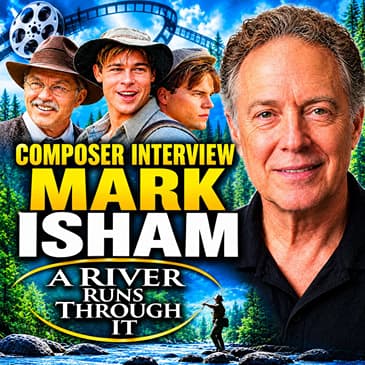
Episode 633
Composer: Mark Isham
Mark Isham is an elite composer, having composed scores for such films as "Warrior", "Blade", "Miracle" and the academy award nominated "A River Runs Through It"
Mark and I discuss his films, movies scores and so much more.
Welcome,
Mark Isham
#ariverrunsthroughit #warrior #miracle #markisham #movie #blade #moviemusic #moviescores #bradpitt #robertredford #montana
darektorscut.com
Instagram: https://www.instagram.com/mondaymorningcritic/
Facebook: https://www.facebook.com/darektorscut
TikTok: https://www.tiktok.com/@mondaymorningcritic
darektorscut@gmail.com
darektorscut.com
[00:00:24] Now nearly all those I loved and did not understand in my youth are dead, even Jesse. But I still reach out to them. Of course now I am too old to be much of a fisherman. And now I usually fish the big waters alone, although some friends think I shouldn't.
[00:01:02] But when I am alone in the half-light of the canyon, all existence seems to fade to a being with my soul and memories. And the sounds of the big Blackfoot River and a four-count rhythm. And the hope that a fish will rise.
[00:01:32] Eventually, all things merge into one. And a river runs through it. The river was cut by the world's great flood and runs over rocks from the basement of time. On some of the rocks are timeless raindrops. Under the rocks are the words.
[00:02:01] And some of the words are theirs. I am haunted by waters.
[00:02:35] Mark, so I'm thinking about your career and, you know, just kind of how you've come up through the decades. Has movie music composition changed over the years since you started? Yes. It has. It has. I started at the very, very, very beginning of technology sort of entering the world.
[00:03:02] It was still all reel-to-reel tape recorders. It was still even mag machines. It was really the most modern thing you could do was write to a tape machine. You know, there was no such thing as computers in music. There was no such thing as digital workstations. There was no, none of that existed. And so, you know, the generation before me was pencil and paper and the piano.
[00:03:31] And the demo was not really anything that existed. I mean, Jean-Michel Jarre, I think, had done Witness, which was on a... Oh, I'm going to get this wrong. What was it? He was using the... Not the Sinclovir, the other one. A Fairlight, I think. But somebody will correct me, I'm sure. But he was using one of the early, early, you know, multi-sample machines. But, you know, it was... All of that stuff was in its infancy. And it was far from prevalent.
[00:04:01] And I did my first few film scores to tape. You know, first to 8-track tape, then 16, and then eventually I grew up and got a 24-track. And I'm overdubbing and I'm building. And I am presenting demos because I was not a trained pencil-to-paper guy. And my world was electronic music, so I came through presenting music in that world, from that world.
[00:04:28] But, yeah, it was very, very different. And so, consequently, it affected the way things are written, too. It's not just the doing, you know. It's the actual notes and the way things are constructed now. Because, you know, you can invest a couple thousand dollars in a laptop and a sound library. And you can compose a film score. You know, and it can sound awesome. So, that alone...
[00:04:57] But you're limited to what you can actually do, you know, in terms of writing and what type of imagination you can fill. You know, you're not going to write a John Williams-type score, probably. Right, right. You're going to write an Otley Olfusson or, you know, the new generation of... Like, Otley's a lot more trained than that. I shouldn't pick on Otley.
[00:05:19] But, you know, there are composers out there that are very synth and sound design-based, you know. Right. And consequently, I think because of the technology, that type of thought process in composing has been allowed to bloom and really rise up and become a very, very viable vocabulary in film scoring. Yeah. Yeah, that's an interesting answer. And let me ask you this. Has it changed in this way to...
[00:05:49] Because I feel like 80s, 90s, maybe even 70s, there's about 15 to 20 of you that I would consider would score a movie, right? There's 15 names, 20 names, you being one of them, that people would score. You know, they would consider to score. I have to tell you, 10 years of doing this podcast, I've interviewed countless composers. I feel the big difference for me on the outside looking in, in 2026, there are... And you mentioned earlier, I don't want to say that these people are like, just bought a laptop and, you know.
[00:06:16] But it just seems like there's many, many more composers than there were 20, 30 years ago. And, you know, we're talking 15 to 20 names when you were kind of early on in your career. Now it's, I feel, maybe hundreds, thousands. Is that accurate? Yeah, I think so. It's become much more competitive. A lot of very talented people. And I think that technology is a big part of that.
[00:06:41] I mean, the technology has allowed a lot of people with immense talent, but who haven't necessarily gone through the traditional training that you had to go through in those days. You had to be able to notate music. You had to be able to, you know, at least work with somebody who could notate music. Right, right, right. You know, I mean, George Gershwin famously could only write in C major anyway, but he got along okay. He figured out a way to communicate to the rest of the world, you know. Right.
[00:07:10] And so whatever it takes to communicate to the world your ideas, God bless you, that's fantastic. It used to be that it took a certain amount of training and rigorous schooling and very precise knowledge of certain types of techniques and technologies and skill sets to be able to do that. And therefore, I think it limited the number of people that could excel in this profession.
[00:07:35] And now you can take a piece of recorded music and you can change the sync of it to 50 different synchronizations to picture and present it to a director in 30 minutes. You know, so somebody can come up with an interesting new piece of music and the technology allows you to present this in 50 different ways. You know, 50 years ago, you couldn't do that.
[00:07:58] You'd have to sit with a picture editor and a music editor and you have to bring all these other skills and technologies and skill sets and trainings. You know, it's really just opened the door to, do I say, just raw talent.
[00:08:15] You know, do you have it? Do you have an ability to get the core thing done here, which is to make a piece of music that's emotional and communicates and communicates in this right storyline timeline to help tell this story. And in a way, it's sort of even the playing field, if you will, to just allow the talent to come through, you know. Right. Right. Because I almost feel someone could score today without knowing an instrument.
[00:08:44] I mean, I'm not saying it's common, but I feel like it could happen. Right. Oh, yeah. You know, which to me, is that does that take away from the authenticity a little, Mark? I don't think so. It's just different. Right. Right. Right. It's allowed a different type of vocabulary to be accessible to the film world. And I think, you know, it's and look, directors are growing up in this same timeline.
[00:09:13] Good point. Good point. You know, they're reacting to these technological changes. They're reacting. Pop music is reacting to all these technological changes. I mean, pop hits are being made in people's bedrooms right now. So, you know, and it evens the field to a certain degree that if you've got the talent, you've got the idea and you've got the persistence to just get it done, you can be in the game, you know. Mm hmm. So in that sense, it's it's it's cool. Yeah.
[00:09:42] And and all of the different disciplines are growing up through that same evolution. So directors now have have heard modern pop music. They've heard modern drone music. They've heard modern rock music. They've heard noise music. They've had all, you know, all the revolutions in the hip hop world. You know, they they're aware of all of that. And so they want that as part of their storytelling vocabulary. So why not? Yeah. Yeah. Let's go find people who live in that world and see if we can get that focused into our storytelling.
[00:10:12] No, great answer. Great answer. Um, let me ask you this. So I've been wanting to tell you this since 1992. There were two and there were two injustices in the 65th annual, uh, sorry, Academy Awards. The first of which was last Mohicans was not nominated. The second of which no offense to Alan Menken, who's very talented. Uh, you were absolutely robbed with the river runs through it. This is a, this is a score mark that I've listened to over the decades and have not stopped to me.
[00:10:42] That's the ultimate of what a score is. I don't know. I'm not baiting you to say anything bad about anybody, but I felt as though I felt as though I'm, I'm looking at the person I felt should have won. Well, thank you very, very much. That's very kind of you. It's it's, I definitely think it's some of my best work and, uh, you know, I'm, I'm, I'm glad I was part of that film. I mean, Bob was one of the most amazing artists I've ever had the honor to work with and just to be part of his team.
[00:11:09] I think we ended up doing four films together and it was really just an amazing experience, you know? Yeah. And I'm going to circle to that, but speaking of injustice, which has nothing to do with you, I will say, um, speaking of injustice, I know this is a man you respect a lot. And I'm talking to a very elite composer. I will say another injustice is Thomas Newman being over 15 at the Academy Awards. That is an injustice. I mean, we're assuming that awards are everything, which they're not, but come on Thomas.
[00:11:36] If Thomas Newman isn't one of the living legends today, I don't know who is. So I just wanted to. Well, I agree. I agree with you there. I think Tommy is one of the absolute best. Uh, he's in the top, top composers of all time. He's certainly, what I love about Tommy is he brought a very fresh voice to film composing. Yeah. And, and not necessarily through technology, just through his personality. You know, he just came up with a different way of expressing things.
[00:12:02] And it's just so cool and so fun to listen to a Tom Newman score. I just, I love his stuff. It, it, that's such a great way of saying it. Um, I did want to say your most underrated score and I love all of it and you've done some amazing things. I have to say warrior is here on most underrated by a, by, by a mile. Um, so I wanted to run this by you. There's a phenomenal scene when Nick Miltie who plays Patty and I'm just kind of reiterating for those who are listening or watching is having a relapse.
[00:12:29] And Tom Hardy has been pushing him to this point, the entire story. Um, and he just breaks full alcohol relapse, stop the ship relapse playing in the background. It's heart wrenching. It's alarming, but your music is driving this scene through the entire way. I got to tell you, Mark, as far as movie moments go, it's up there. Um, what a beautiful track. What was your take on that scene after music cinematography, any of it?
[00:12:55] Well, I think warrior, I could be so bold. It may be the best picture I've ever scored. I mean, I just think as a, as a film, look, I've been very honored to be a part of some really, really well-made films, but Gavin. Gavin's a very special director. He really makes beautiful films and warrior. I certainly think is his best. And it is just one of, one of the great films.
[00:13:23] And, and I, and I do think that film is overlooked. You know, that film had very little traction when it came out and it's picked up its recognition since I think because people that find it say, oh my God, this is just an amazing film. Um, that scene is one of the most heart wrenching scenes ever filmed.
[00:13:46] And, and certainly I had to really make sure I didn't screw it up to make sure that, you know, a scene like that, if the music overplays it, you know, can be terrible. And so you have to really, especially the way Gavin makes films, you, you really want to just, you want to be in the wallpaper of the scene. You know, you want to be just something that is just, you don't even notice it.
[00:14:15] But at the end of the day, that music has supplied 40% of the emotion of it, but you never felt that it was coming from the music. You just felt the film and you live the film and you were in that film. And the music has helped create that illusion. Mark, you're, you're that track to stop the ship in that case. It, it, it magnifies Nick Nolte's pain. Like it's, it's the music doesn't hijack the scene, but it sure as hell magnifies every moment of it.
[00:14:44] Like I can't even begin to tell you how that track really, really, really adds to that phenomenal scene. Well, thank you. I mean, that was my intention, you know, it's, I mean, he's one of our great actors. Gavin got a great performance out of him. I mean, Tom Hardy is of course, as well. And it was just, uh, yeah, I w I was very proud that I did that. I did right by that scene. Mark, when it comes to that scene, do you score the script? Which is the scene?
[00:15:14] Do you score the scene when it's done with maybe a temp track or nothing there? How does that work when you decide this is the right piece of music in that particular case? How did you score that? I don't believe there was a lot of temp music in warrior. Um, maybe that's the wrong word. Maybe that's the wrong term. Like, well, that's the right. That's the right term. That's definitely the right term. Gavin is interesting in that way.
[00:15:40] Some of his films, like I remember when we did a miracle, there was a lot of temporary music in there, but we never worked together. That was the first film we did together. So I think he was, he needed to know that his film was working and you put temp music in to find out if things are working. And you also put temp music in to find what kind of music is working. So you know who to hire. We want to hire somebody who writes, you know, sort of in that world. Yeah.
[00:16:03] You know, uh, and that's why I got hired because I'd done a fair number of sports movies and, and, uh, and Gavin, I got along right from the day we met. And so he hired me for, for miracle and we just stuck together for, I don't know, 10 years.
[00:16:20] But so warrior was probably even, even more up my alley because not only is it a sports film, but it has those sort of moments of just real isolation and minimalism, which is something that I really, uh, I think I'm pretty good at that.
[00:16:37] Actually, I, I, and maybe it's my obsession with miles Davis, but less is more, you know, just think the least about you can do to get the most, the greatest effect is, is my motto. So in that scene, particularly, you don't want to step over those performances. You want to just, like I say, you want to be the right shade of wallpaper. That's just making this thing be alive, you know? Yeah. Yeah. That's such a great answer.
[00:17:04] And I have to say in a different way, the same thing happens in miracle when her Brooks goes in the tunnel after he wins and he's like, it's such an emotional moment. And again, your, your music's driving the scene, but not hijacking the scene. But then again, it's really essential to the scene. So what a complex mix that is, Mark, to have all those things. I don't know how you guys do it, especially as an elite composer. I don't know how you do that, Mark.
[00:17:26] Well, I got to say the one of the, that's one of the great things about the new technology that we have, you know, those were those films were what the nineties. So if you'd gone 40 years before that and scoring a film like that, you're doing this on a piece of paper and a pencil and you're playing it out on the piano and you're kind of working through it.
[00:17:50] And you really don't know how it's going to play until you're in front of the orchestra or the band or whoever is going to perform this music and you see it up against picture. Well, the great thing about the technology we have now is that you can demo these things and you can make demos on your computer. And you can, long before you play them for a director or producer, I can sit there at two o'clock in the morning and play this thing for myself and say, am I overplaying this? Am I underplaying it? What is, is this the right balance?
[00:18:19] Is this the right sound? Do I need a trumpet there? Did you take the trumpet out? I can ask myself all of those questions, you know, in the privacy of my own room long before I bring in any filmmaker so that I have the confidence that I'm doing this right. And 50, 60 years ago, you couldn't do that. You had to wait for the scoring stage.
[00:18:41] And if the director says, oh my God, you're just stepping all over everything and you have to sit there with the orchestra and say, all right, take the trumpet out, take the horns out, you know, only half the violins play. You'd have to fix it there. And God bless the guys that went through that and made the great scores they did. I came up just in the beginning of the tape machine as a piece of, as a compositional tool.
[00:19:08] So I could use at least the tape machine to try things out and get things right, you know, before the producers or the directors would come in and answer all those very same questions that you ask. You know, I would be able to ask myself those and give myself the right answer so that I would have the confidence to play something and say, this is the way it should be. You know, is there a scene in particular working on Miracle and Warrior that you're especially proud of?
[00:19:36] Listen, they're both scores that I own and that I love, both hard copy and digital. Is there something that you really appreciate, a scene that maybe popped more than you even expected when you were scoring it? Yeah, I can think of one in each film. I mean, in Warrior, the fight with Tommy Riordan and Koba. Yeah. You know, this is, this is the first big fight that Tommy has to fight and nobody thinks he's going to win.
[00:20:06] There's not a person in the world that thinks he's going to win against the biggest, toughest, roughest guy who's expected to take the whole thing. Hmm. And to score that with a sense of, well, he's our hero. We paid our $11 to sit in the theater to watch a movie about him. He's probably not going to lose, but we need to feel that he's going to lose.
[00:20:33] And then when he does the thing that he does and slips the hand around the neck at the right point and the guys in the booth go, wait a minute, he's in deep. He's in deep. And the music has to just sell that because we don't know. We don't know he's in deep. We don't know what that hand around in that position means. So the music has to say, you know, this, this little fucker is going to do this.
[00:21:01] And so that, that, and yet you have to do it in a way that fits with the mood and the, and the, the beauty and just, you know, Gavin's world. And so I was very proud of that. I thought that that scene turned out very, very well. I was very proud of that. But in Miracle, there, there's a, a scene that may get overlooked, but it's in the move. It's in about halfway through.
[00:21:26] And I think it's, and it's a, it's a montage over Jimmy Carter's speech about, you know, we have to pull ourselves together and it's been tough and, and it's a real speech. It's Jimmy Carter talking, you know? And I wrote a piece for that, that I just, I really love. I just thought it had the right sense of nostalgia and bittersweet sadness. And yet Jimmy is trying to be hopeful.
[00:21:55] He's trying to inspire the American people, you know, but that's not who he is. He's just a laid back guy. Yeah. And it was a balancing act, but I think that, that piece, I really love that piece. I play that piece just as a piece of music from time to time still, even years later. Do you listen to your work often, Mark? Like I listen to your work all the time. I'm not like just telling this because we're speaking.
[00:22:22] I legitimately have listened to A River Runs Through It and the, you know, Warrior and Miracle. I'm telling you, since, since they came out. Only that the, A River Runs Through It, because it came out longer ago, it was 92. And I got to tell you, it's like, that's the one thing I think about being a composer, Mark, with your work. Yeah. I love the movie A River Runs Through It, but your music has stuck with me that whole time.
[00:22:45] The movie still has, but I can throw that music on in a car and still love it in 2026, the same way I loved it in 1992. You can't say that about any other facet of a movie. Like your music is something I could take with me. I can have it. And I, it's there for me to, and I remember memories with my father. I don't know. I just, I can't convey how special that is, Mark. Well, thank you. Thank you very, very much. I mean, that is obviously why I do this, you know. Yeah.
[00:23:14] And why I think music is such a special language. It really is a language unto itself. We don't have anything else in our, any of our planetary cultures that, that can rival music for having that quality of just speaking to you very personally, to each individual that has a personal communication. And it's, and it just seems to stand the test of time. It just, it can be this thing.
[00:23:42] You know, I, I, that's why I do it. I, you know, I've been doing a long time and I'm not stopping anytime soon. You know, I think it's the most fabulous language we have in all the cultures that use music. And I don't think there's a culture that doesn't have some form of music. And I just think it's just one of the most fabulous, interesting phenomenons of life that there is. Yeah. And I wanted to hop into where it runs through.
[00:24:10] And I have to say, what's interesting about this score, because this is another one I own on CD and digitally, is track 32 or 33. I think it's 32. You kind of give a little interview, which I thought was really cool. I never heard that on a soundtrack. You give it. I just thought that was really neat, Mark. It kind of, I'm like, because this is when I first listened to this, I'm like, not something I really heard before. And it's just so good to get what you thought in a time where, you know, access to composers was not common. So what a clever idea, Mark, to do that.
[00:24:39] Well, I can't take credit for that. I mean, obviously that is me speaking. Yeah, yeah, yeah, yeah. That was, that was, I think that release was a re-release by Malone Records. And I think they, I could be, I think I'm right about the label. But whatever label that was, it was their idea. And they said, we would love to, because by that time it had its nomination and it had sort of garnered a certain amount of respect in the community. And I think they wanted to make it a special edition.
[00:25:08] And they said, well, can you throw in the special edition? And they said, oh, here's this great interview. Let's put that in there. So I'm glad, I'm glad it works for you to have that there. It's very clever. And for those who don't know, Elmer Bernstein was tabbed to score, runs through it. Robert Redford, basically, I'm summing this up. Basically says, it's not right. This is not something I, you know, I don't, I'm not connecting with Elmer. He's an icon, obviously. In an interview, though, it's so interesting.
[00:25:37] He says he, Elmer blames himself. But then he ends the interview by saying, Renford's a confused guy. He can never make up his mind. And I'm like, I don't get what you're saying. I was like, okay, he's going to take the high road. And he kind of took a little dig at Robert. But I have to say, considering the amount of times you've worked with him and, you know, what you brought to it. I don't know. I just, I feel like that was a gutsy call on Redford's part. And what you did over that four-week span, I don't think I've ever heard anything like that.
[00:26:04] With what you created in that four weeks, there isn't anything close to that. As a movie composer fan, I can't remember anything like that, Mark. Well, thank you. Thank you. I mean, talk about intimidating. I mean, Elmer is an iconic composer. And I remember getting the call that, you know, Bob Redford wants to meet with you on this film.
[00:26:31] And which I was delighted about because I had spoken to Bob about a couple of different films. I had spoken to him about Milagra Beanfield Wars and he didn't hire me. I'd spoken to him about one other film in there and he hadn't hired me. And then all of a sudden he calls me and plays me in the film and says, I need you to score this. And it's already been scored by Elmer. And I went, holy shit. You know, this is, you know, really?
[00:27:00] By him and you're throwing it out? And you want me? You know, this is insanity. And then I saw the film and I'm sitting through the film and he'd taken Elmer's score out and he'd put in a bunch of temporary music. And I'm watching this film and I'm going, I don't know. I don't know how to do this. I have no concept. And I decided that when the lights went up, I was going to get up and say to Bob, I'm not the guy.
[00:27:28] You know, you need to find somebody who can really do this for you. Until the last scene came on. So the lights hadn't gone up yet. I'm sitting there just completely devastated in my seat. And the temp music was a Jean-Pierre Rompol, the flautist, had recorded an album of Irish folk songs. And they had put one of those Irish folk songs. Not a famous one, but just a really beautiful, beautiful one.
[00:27:57] And it was playing over that last scene when, and Bob, of course, is doing the narrating himself. And it's over and he's got Norman, I forget, it's Norman. It's the last name. McLean. McLean. McLean. McLean, yeah. He's got Norman McLean's beautiful words and this music. And I just went, well, that works. That's absolutely perfect. And so I said, well, that's it.
[00:28:25] I just have to write five or six beautiful Irish folk songs and figure out which scenes they go on. And that's the score. And so I got up totally confident and said, all right, let me get to work. And that's what I did. I literally sat down and just in about three or four days, I wrote like five or six sort of Irish Americana folk songs. And then just started placing them in different places in the films.
[00:28:53] And, you know, for the river, I orchestrated it in certain ways. But, man, up until that moment, I was convinced that there was not a chance I would know what to do with this film or especially replacing Elmer. I mean, this was like – and to this day, I have never heard Elmer's score. Wow. I refused to hear it. Except for one scene when I just couldn't get it right. And Bob kept saying, eh, it's not quite right. And I don't know.
[00:29:20] And in Elmo's defense, you know, I found Bob to be a great communicator. Bob was very articulate. But he would also be the first to say, I don't know, which was great. Which is great, yeah. But if he didn't know, then we're both kind of sitting there looking at each other saying, well, neither of us know. What are we going to do? And I couldn't get this one scene correct. And he said, I don't know. It's just not working. But I don't know.
[00:29:48] I don't know how to – I said, did Elmer's cue work here? And he said, yeah, that wasn't – Elmer's wasn't bad, actually. I said, all right, play me Elmer's. And that's the only time I heard an Elmer Bernstein cue in that film. And he played it, and I said, oh, I get it. I see. You know, there's the pro doing the right thing for the right scene in the right way. And so I could move in that direction and make the Isham version of that type of music.
[00:30:16] And yeah, then it was done. What does Redford say to you after he hears everything done and complete? Is he taken back? Is he – I mean, because he makes the choice – a very difficult choice. So when he hears this epic score come out, does he say anything to you? Is he taken back? I think he was relieved.
[00:30:38] I think he knew he made a very brave choice in hiring a relatively inexperienced guy to do a score that this guy had never really done before. You know, I was the electronic guy. You know, I was – I had done – you know, I had done some melodic scores, but nothing big sweeping orchestral scores before. And this was sort of the real – really the first one. And so Bob was very brave to choose me.
[00:31:08] And I asked him towards the end. You know, when he came out of the house, I think, towards the end, and he was happy with all the cues. And I said, Bob, I just have to ask you, why did you hire me? I'm just – because it's a very brave move for you to have done. And he said to me, years ago I saw Never Cry Wolf, which was my very first film. And I said – and he said, I wrote down your name because I said that's somebody I need to work with in the future.
[00:31:38] And he just – For some reason on this film, which couldn't be more different than Never Cry Wolf. Although that's – the film itself isn't because they're both about nature and they're both about the beauty of nature and man saving nature and being involved in nature. So thematically the films are very close. But score-wise, I scored them very, very differently. Yeah. But it was – yeah. I mean, Bob is – he was a remarkable, remarkable man.
[00:32:07] I mean, there's no reason – every reason in the world for him to be the iconic person he is because he was just – they don't make a lot of people like that. No. You know, if they released these 30 tracks that you created, not associated with the movie, you just made 30 tracks of music, this album would have been a classic even not related to a movie. I just feel like we talked about music being, you know, overpowering in some ways. This is – I don't know what the word I'm looking for is.
[00:32:34] It's – you certainly know when you're hearing this song that it's something special. Like, it's not an in-your-face type of – but it's so memorable. Like, you'll never forget some of those hooks in those. There's so many. One after another after another. It's just – it's beyond memorable. And I don't know how you did this in four – like, I can't – I can't fathom that. I can't put that together in my non-music brain. I can't put that together. Like, I was listening to this score today again. I'm like, what is this four weeks' worth of work?
[00:33:03] This seems like you spent years on this. Well, you know, necessity. Yeah. Dark, I mean, come on. If it says, you know, you're working with one of the greatest filmmakers of all time, an iconic person who, you know, comes to your front door and your wife is speechless because he's the biggest movie star in the world. And you're working with this guy and you're replacing Albert Bernstein and you have three and a half weeks. This is it. This is like your shot.
[00:33:32] So are you going to rise up and do it or are you going to fall apart? And I really think necessity is the mother of invention, I think, is the old phrase, you know. And it really is. It just – look, I worked 14, 16-hour days. You know, I was in there at 9 o'clock in the morning. Went to bed at 2 a.m., 3 a.m. You know, to get it done. But it got done. And I got to hand it to Bob.
[00:34:01] I mean, he was very patient and gave me a lot of time because he knew, you know, for him too, you know, he was putting his cards in a basket, which was not predictable. And so, you know, he had to go back to Connecticut at one point. And this is long before FedEx or anything like this.
[00:34:21] Listen, I was sending cassettes by special courier to some post office in Connecticut that he would have to get a car to drive. I mean, the convolutions that we had to go through to get this score done in three and a half weeks was – without the technology we have today, it was pretty funny. So he comes to your house personally at one point and your wife sees him. She must have been flabbergasted. Like, holy cow. Like, just talk about how things have changed.
[00:34:50] And that must be – that alone must be a phenomenal memory for you. Well, that was funny because my wife is very outgoing. She'll talk to anybody. She is the quintessential Jewish mother. She's just like – Yeah, yeah. And she said, oh, Bob's coming. Great, great, great. She opens the door and he says, hi, I'm Bob. And she is speechless. She can't even get a word out of her mouth. It was very funny to see. Because there he was.
[00:35:17] There was the biggest – at the time, probably one of the biggest movie stars in the world at that time. You know? Yeah. And probably if we look at the last hundred years, probably top five, ten all time. Like, he's just amazing. Never mind his stuff with being a director, which is out of this world. Do you think that your scenario plays out different? Do we end up in the same place if Bernstein is not part of the equation? If it's just you getting the job right away, you have, you know, three months, whatever it was. And do you think it turns out the same?
[00:35:47] Or do you feel like having that short period of time almost pressed you to work in overdrive? I don't know if that makes any sense. That makes perfect sense. And I think it's true. I think in a way, the fact that I had less than four weeks to do that job was a boon. It was a good thing. Because if I had been – had enough time to get worried and intimidated and second-guess every choice, I probably would have fallen apart. But I didn't have time.
[00:36:15] I had to just – I had to do something and say yes or no. No, that's not good enough. Yes, that's good. All right, move on. Next. I mean, I just – you just had – there was no choice. You know, no choice to dick around and second-guess and just – I had to move. And I think that's good. I think that's great for the creative process. I really do. Yeah, I agree. So I was listening today – listening – listening movies that I felt had a perfect score, perfect cinematography, and a perfect story.
[00:36:42] I came with Shawshank, Road to Perdition, The Green Mile, Interstellar, and A River Runs Through It for me. Wow. You know, and we're talking you, Newman, and Zimmer as composers in those movies. But I'm serious. Those movies – those movies, when I watch them, it's like comfort food. I'm like, ugh. Like, these are all moving murals. Like, I just – I can't explain to you how much I love those films, these films. Yeah. Well, you're obviously a Frank Darabont fan. I do.
[00:37:12] I do like Frank Darabont very much. I do. And I don't know. I just feel like the score defines the movie. I have a few more questions, and thank you for all this time, Mark. I really appreciate it. Let me ask you. When you realize – or when I realized that Norm McLean was actually – he was writing about his life, Montana, water, the fact that his brother Paul did indeed get murdered. Does that – the score hits even harder, if that makes any sense. Like, when I read that afterwards, I was like, holy cow, this man is pouring his heart out.
[00:37:42] This is – you know, I know there's some stuff that's maybe – I don't want to say embellished, but, you know, it fits the narrative, but the heart of it remains the same. It's true. Yeah. So I feel like your score is almost a soundtrack to his life in some ways. Well, yeah. Yeah. And, you know, what's interesting to me is that I loved Bob's narrating it, Bob reading Norman's words. I just – that, to me, had such a magical quality.
[00:38:09] And I think once Bob saw that I had a handle on the score and he could sort of be a little not so nervous about me and he could think about other things, he started to think about the narration. And he was bound and determined not to be the narrator of this film. He said that's a scratch track. It's there just for a placeholder. It's just there for timing. It's not me narrating this film. And he brought in – I don't even know the list, but it was a long list of people that he had narrate this film.
[00:38:39] And what's in the film? I mean his words. Bob reading Norman's words. I mean it's – he had such a command and love of that, of those words. And he could express them, I think, in a way that he couldn't find anybody else that would do a better job. And everyone around him said, no, Bob, yours is better. No, no. No, that's great that you had Ralph Fiennes in there. But no, no, you're much better.
[00:39:07] I mean the list, I don't know if Ralph was on it, but people of that caliber. I mean just like top actors from all over the world came in and read this thing. Yeah, yeah. Bob is the one. It sounds like he knew what he wanted from the start as far as what would work, and he had a good pulse of that. I want to ask you about one last scene. By the way, rest in peace, Tom Skerritt. Boy, does he make your music come alive and vice versa. You guys make an awesome team. Not obviously doing it on – well, you're doing it on film.
[00:39:36] But it's just the way he acts, the way your music affects him. It's just – again, it's just so – it's just – it's like a glove. So when Reverend McLean is speaking to his congregation and he talks about loving completely without complete understanding, he's clearly talking about Paul. The scene transitions to Norman Fishing. I'm haunted by waters. And then you hear from everything I just mentioned, in the light – in the half light of the canyon is playing, driving this.
[00:40:02] So while I told you about the warrior quote before, this is indeed a top five scene all time for me. This hammers the whole thing home. And, Mark, I'm telling you, if I gave Thomas Newman a shot at this, Zimmer a shot at this, everybody a shot at this, nothing tops in the half light of the canyon, driving that final scene home. And my goodness, I've probably seen it a thousand times. And I wish I was exaggerating because it sounds like I have no life. Yeah, yeah.
[00:40:28] But, Mark, I'm telling you, that is – if somebody says, why do you love movies, I would put that scene in and I would say, just watch this and we'll talk afterwards. That's my thing. Oh, wow. Well, thank you. Thank you. That was obviously one of the big – it's the big scene. You're wrapping it all up. You have to make it all make sense. And quite frankly, I didn't score that to picture. I took one of the things I'd written.
[00:40:55] I had three, I think, songs that I had written that I thought, well, one of these will work at the end. And I don't remember in which order I tried them. But as soon as I put that one up and scooted around and said, well, wait for him to finish that word and then start. And it just laid right in there. And I said, that's the beauty of not thinking too much about it, just letting creativity take over. And there it is.
[00:41:22] And, of course, the great thing about that score was that my contractor found these incredible performers. You know, Louise Turturro played the flute on that score. And she just – the first moment she played that very first theme, I went, oh, shit. That's it. That's the sound, you know.
[00:41:46] And then the harpist, Katie Kirkpatrick, I mean, who brought in the Celtic harps and the regular harps and everything. And I just said, yeah, I mean, all of a sudden these silly little demos that I had been making, all of a sudden there's just real life and beauty is there. And this is the sort of score, of course, you have to get those performances. You know, there's no electronics in this music. This is all just the finest musicians that the world has to offer.
[00:42:14] And they're taking what you put on the page and they're making something just exquisite out of it. You know, and it's got to say – and Sid Page. That's where I discovered Sid Page. Actually, it's not where I discovered him, but that's where I knew of Sid Page. I said, Sid, you know, they offered me the greatest concert masters and everything. I said, well, they can come and be concert master, but the soloist is Sid Page, the violinist. And they said, well, who's Sid Page? And I said, well, Sid Page is a classically trained violinist.
[00:42:43] He played with Dan Hicks and the Hot Licks and Sly and the Family Stone. So if you want a soulful Americana violin, I don't want the concert master. I want Sid Page. And he gave us that feeling. He gave us the feeling that he'd been playing in Nashville, Minnesota bars all his life. But his intonation is perfect. And he was a secret weapon for me for years, Sid Page.
[00:43:12] Mark, does your music in a scene ever make you emotional? It could be a river run through. It could be something else. Like when you're rewatching the scene I just talked about. Does it blow you away at points where can you take time to appreciate what I appreciate, what I see? Do you get affected like that? There are times. Yeah. Yeah. If I've been far, especially if I'm far enough away from it, you know, and I'll look. And something will come on. I'll let it play. And I go, oh, you know, that's. Heron Meyer stood up.
[00:43:41] I did a good job there. Mark, you ever have an actor compliment you? Because I really do. And I mean that. Like, I think your music has certainly magnified many scenes. You ever have an actor come up to you in any of your projects and say, hey, phenomenal job. That score really drove this film along. Anything along those lines? I do, actually quite a bit. I mean, just recently I've done a TV show and I had, well, Titus Welliver. I've interviewed him.
[00:44:11] He's very nice. He's very kind. He's a great guy. Yeah, yeah, yeah. He talked to me and a couple of the other guys. Man, love what you did there. It really made me come alive. But I've had that over the years. I mean, Gary Sinise was always great about that. Who else has come up to me? I've been very fortunate with, you know, on several of the Darabont films, actually. Oh, who's the guy that plays the Punisher?
[00:44:41] Not Berthal. Yeah, John Berthal. Okay, yeah. John loved what I've done for him, like on The Accountant and stuff like that. Yeah, that's great. That's such an awesome thing to hear you say. My last question. Do you ever – I don't know if you do this. I know Zimmer does it. I've been to his. John Williams does it in the Berkshires for us, for his fans. Do you ever bring your music on the road and have shows like that? Because I would love to go to something like that. I have in the past, yeah. Not in America. I've done it in Europe.
[00:45:11] I've done it in Spain in a couple of places. I've done it in Poland. But, you know, I've just made a new solo record, non-film music record, and I've premiered it and played about half of the record live at a documentary premiere. There's also a documentary about me. And I got really excited about playing live again.
[00:45:35] And so I'm debating – I'm putting together a little clip for booking agents, which I'm going to take to them and just say, can you sell this? And we'll just see if booking agents would be willing to put together an evening with Mark Isham. And we would do stuff from my albums, but then we'd probably also spend, oh, 30%, 40% of it on film music as well. And it's all with video. So it would be – I think it would be quite a fun evening for anybody to come along and see.
[00:46:06] I would travel for that. I know you have Massachusetts roots, so give us a chance to come back. So anything else around the corner for you, any social media you want to get out there? Wait, let me ask you this. You mentioned a documentary. When does that come out? Can you tell me anything about that? Yeah, it's on the Scientology Media Channel, which is 320 on DirecTV. And it's part of a series, a documentary series they have there. They've done – it's called Signature Performances.
[00:46:35] And they've done Chick Corea, Stanley Clark, and myself. I'm the third in a series. And it's out now. It's been out about two weeks. It's been very successful so far. And, in fact, it just got nominated for Hollywood Music and Media Award. Nice. Nice. That's out. The album itself, at the Carousel Club, is out on all your favorite streaming channels. I can be shamelessly promotive here for a second. No, please. And you're on Instagram, too, I noticed, which is great.
[00:47:05] Anything else you want to throw out there, Mark? I don't want to rush you along. No, no, that's fine. I mean, you know, the most recent TV show I think I've done is The Westies. That had a nice run. Let's see. I have a film that probably won't be – that we're finishing up this week that probably won't be out until next year. So I'll have to wait on that one. But – Was Westies MGM – I'm trying to think. Westies was MGM. Yeah, that's a great show. Yeah. Yeah.
[00:47:36] That's a really – Go ahead. I'm sorry. I interrupted you. I'm sorry. No, that's quite all right. You're exactly right. It's on MGM, and it got really, really great reviews. People seem to really love it. Good show, yeah. So I'm mostly working on the album, promoting the album, and finishing up this film. That's where I'm at right now. Mark, you're a legend, and honestly, I can't thank you enough for what you've done. Your music has been with me as I've grown older as a human being, and as an artist, I just –
[00:48:04] I can't thank you enough for what you – how you've affected my life, Mark. Well, thank you. That means the world to me. I mean, that's why I do this. I mean, music is a beautiful language, and it can really impact people's lives and make them, you know, make better lives. And the fact that that's happened with you, I'm very grateful and thankful, and I appreciate you telling me that. It means the world. We'll be right back. Bye. Bye.